By Jeff Hare, Tradewinds Instructor and owner of Emerald Sea
Sailing Vessel Emerald Sea sends her greetings from Gulfo de California!
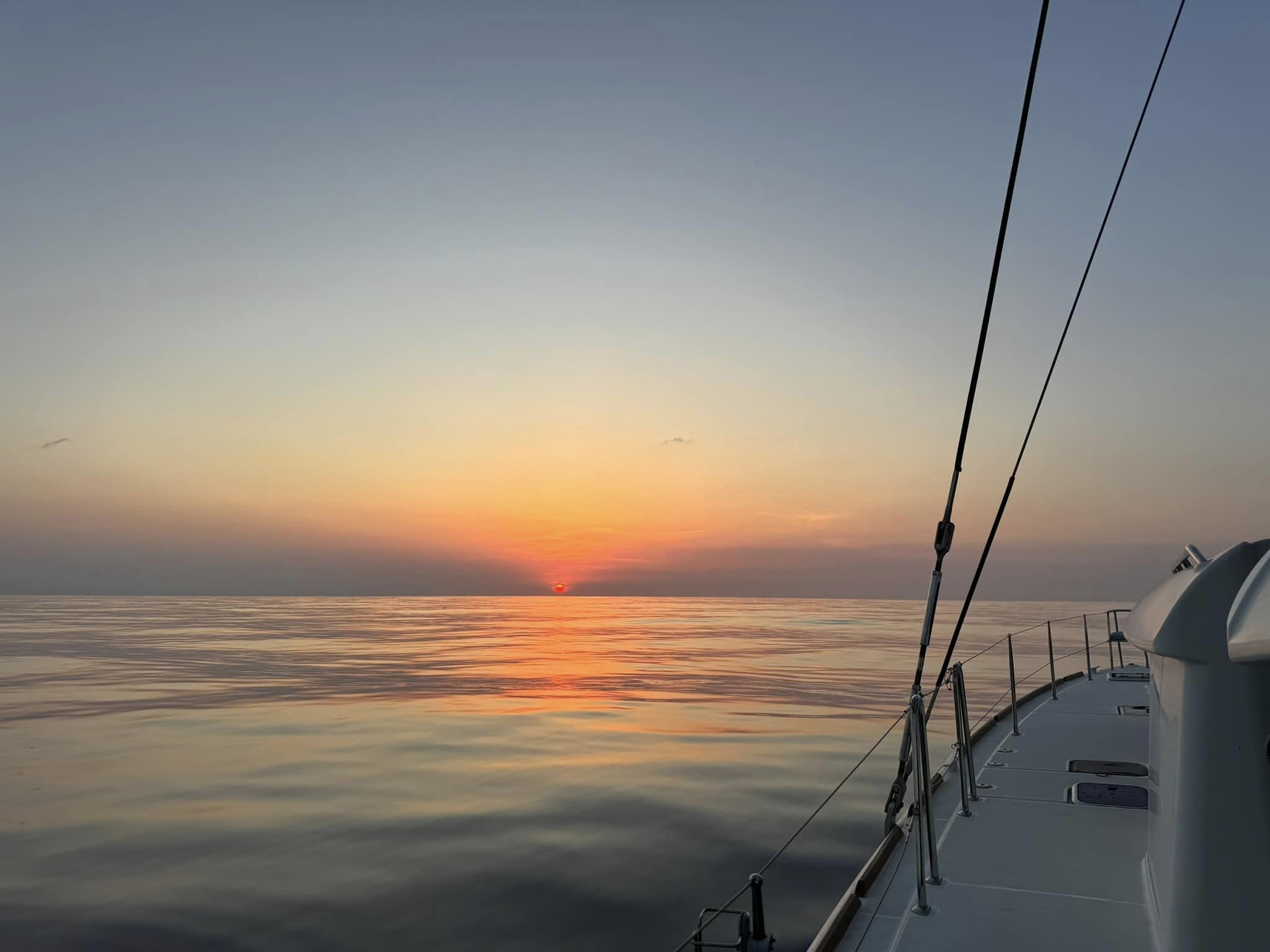
We have enjoyed exploring several islands in the Mexican National Park system and highly recommend anyone visiting to just go buy the annual pass at this website as it apparently covers all parks. Because you can’t get it all done in a day, save yourself the annoyance and get the annual pass! The water here is an inviting emerald and you just don’t want to get out of it. Hiking the islands offers vistas that are difficult to describe. I cant tell you what a joy it is to meet other cruisers and swap sea stories. You might hear about the strong north winds – be prepared to hunker down for these as they may last a day or so (this is why we bring books to read), but the calm days between the wind storms allow you to move north toward your next adventure at a new and interesting place.
The wise words of the Grand Poobah are not wrong; “Wish you were here!”…
Another bit of advice: We allocated a month to explore the northern areas of the Sea. That’s not enough! Expect to spend an entire season because there is so much to do and see. Come with patience as you will have to occasionally tuck into a protected anchorage for the high winds coming from the north, but you will be rewarded by several days of mild weather, pristine air and water, and sea life many people only see on television – your next new place to explore is only a few hours away! The air here in the north is cooler in the evening, so we had to occasionally wear long pants, long sleeved shirts, sleep with a blanket, and even real shoes (I hate shoes!)
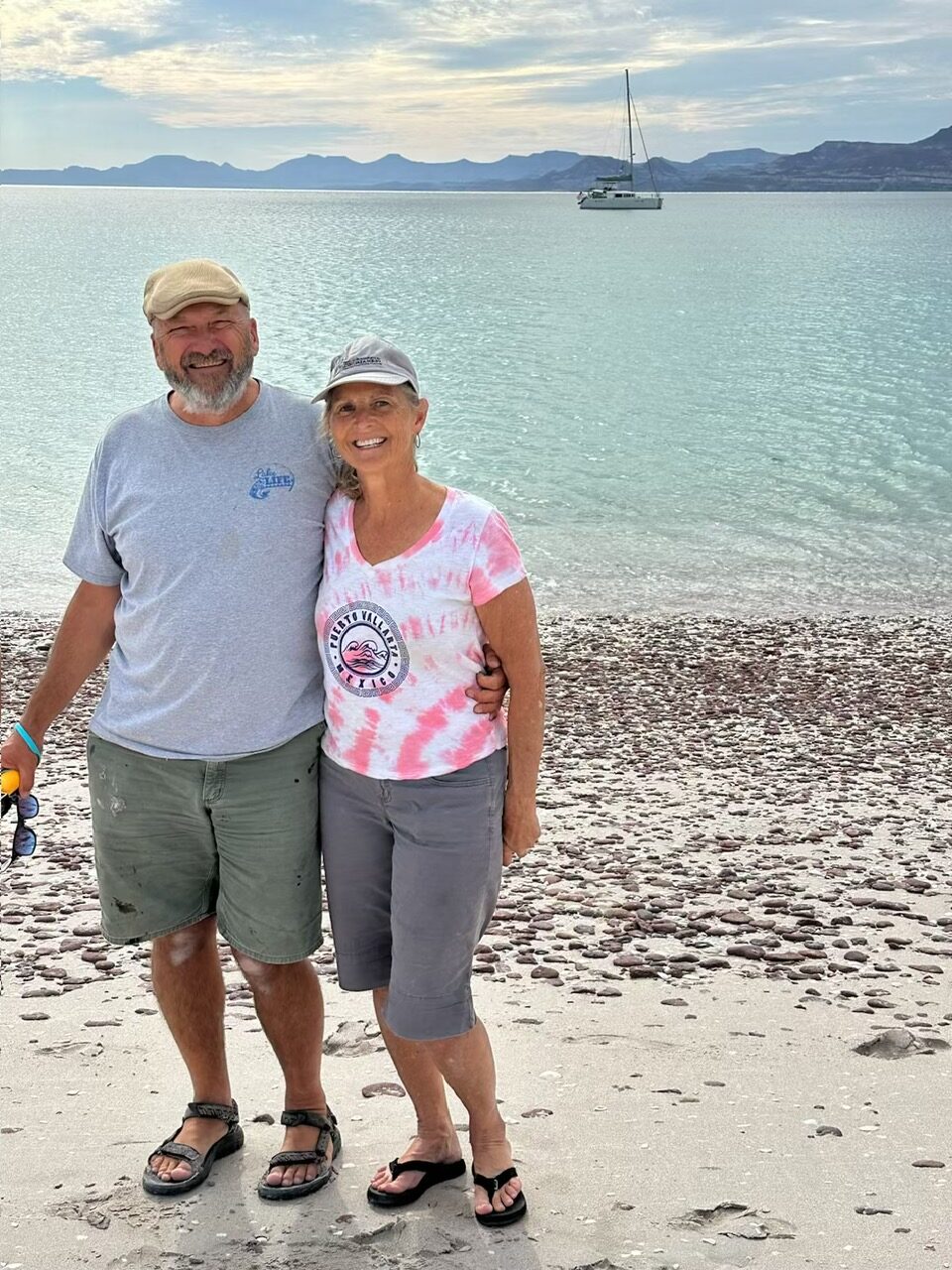
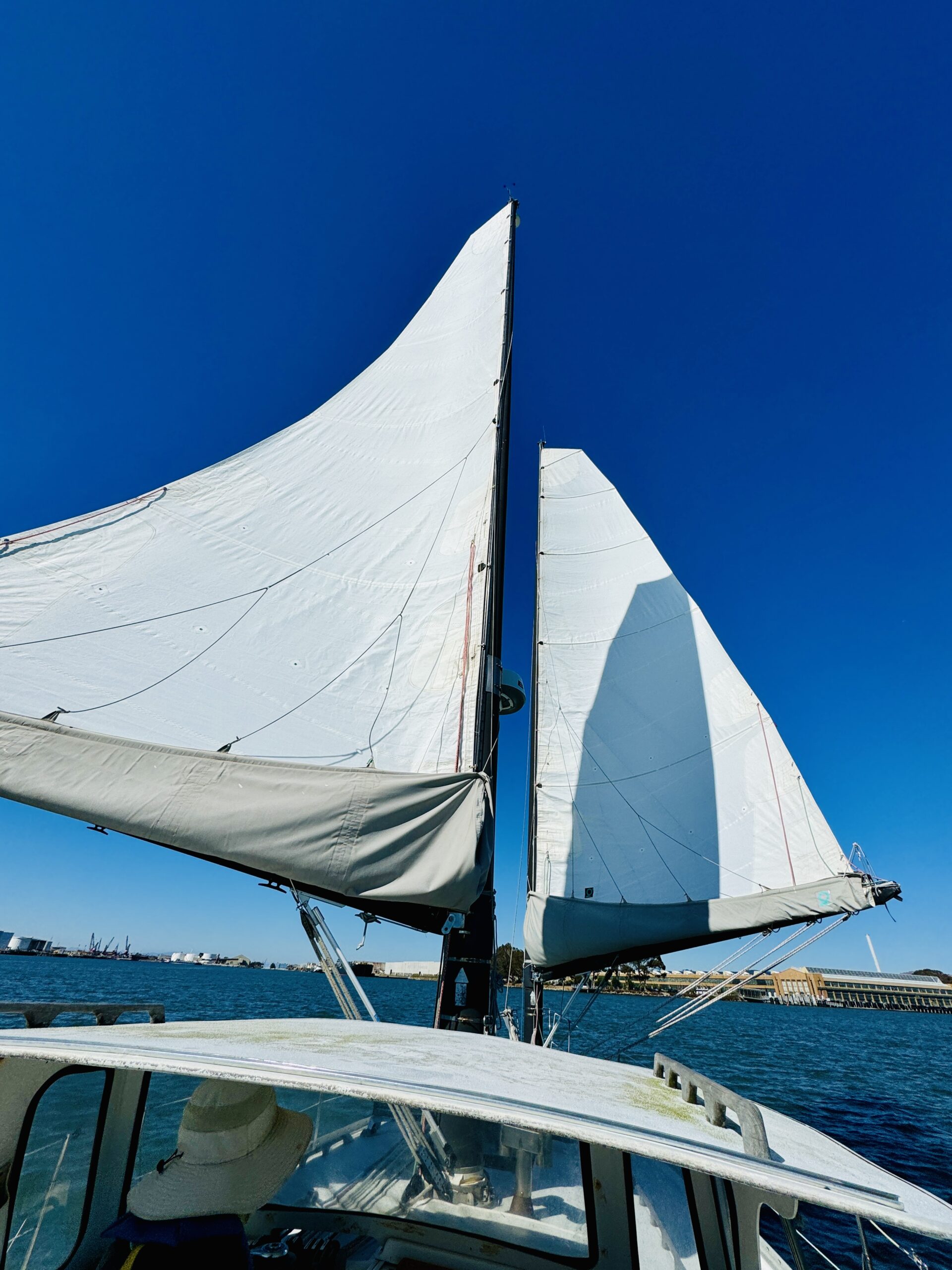
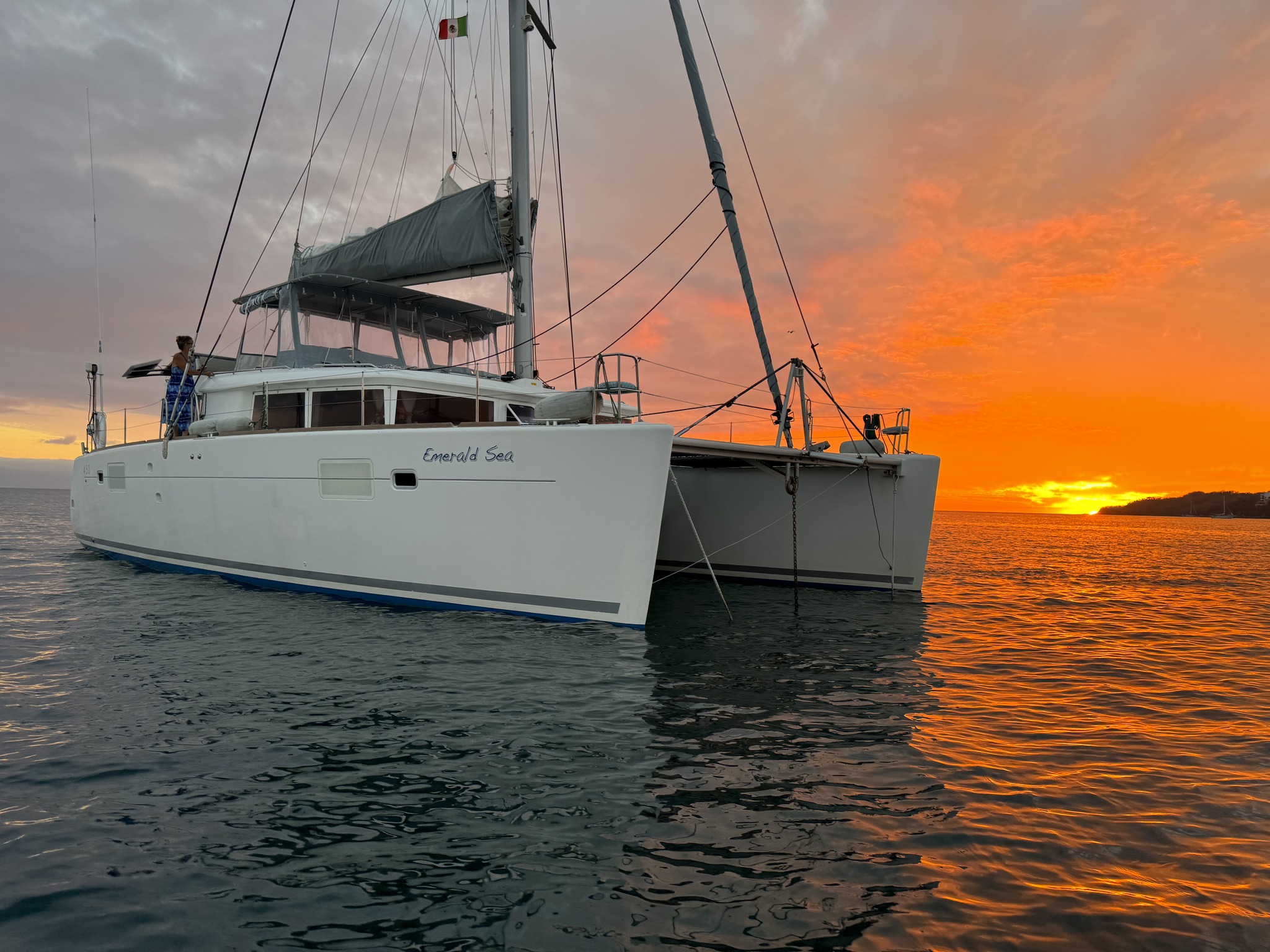
The attached photo encapsulates what I am talking about – Sailing Vessel Emerald Sea on the Emerald Sea of Cortez! While I already quoted the Poobah another appropriate quote from Warren Miller comes to mind (when I used to enjoy winter sports): “Do it! If you don’t do it this year, you will be one year older when you do”.
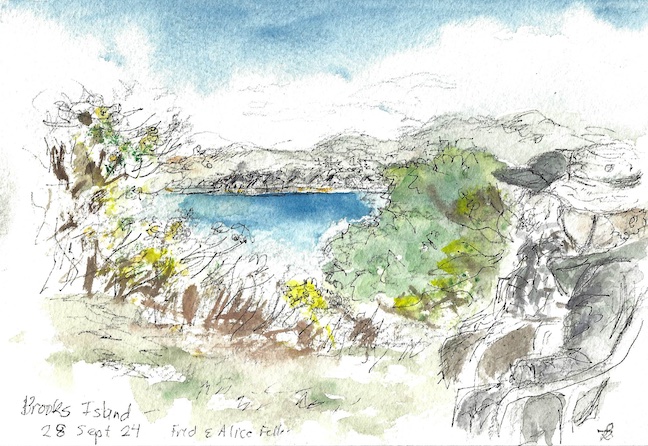
I pass Brooks Island many times as I teach sailing classes admiring the beauty of this mysterious place, at the same time I cringe at the pungent smell of bird poop coming off the windward side which signals to me a healthy thriving bird population on the island. Through my numerous days of sailing on the Bay I only come to its shore once a year.
2024 is the 4th consecutive time I was able to participate in the Coastal Clean-up Day organized by Tony Johnson, one of our own TWSC Sailing Instructors, Matt A., the Island Caretaker, the Regional East Park Service, and Tradewinds!
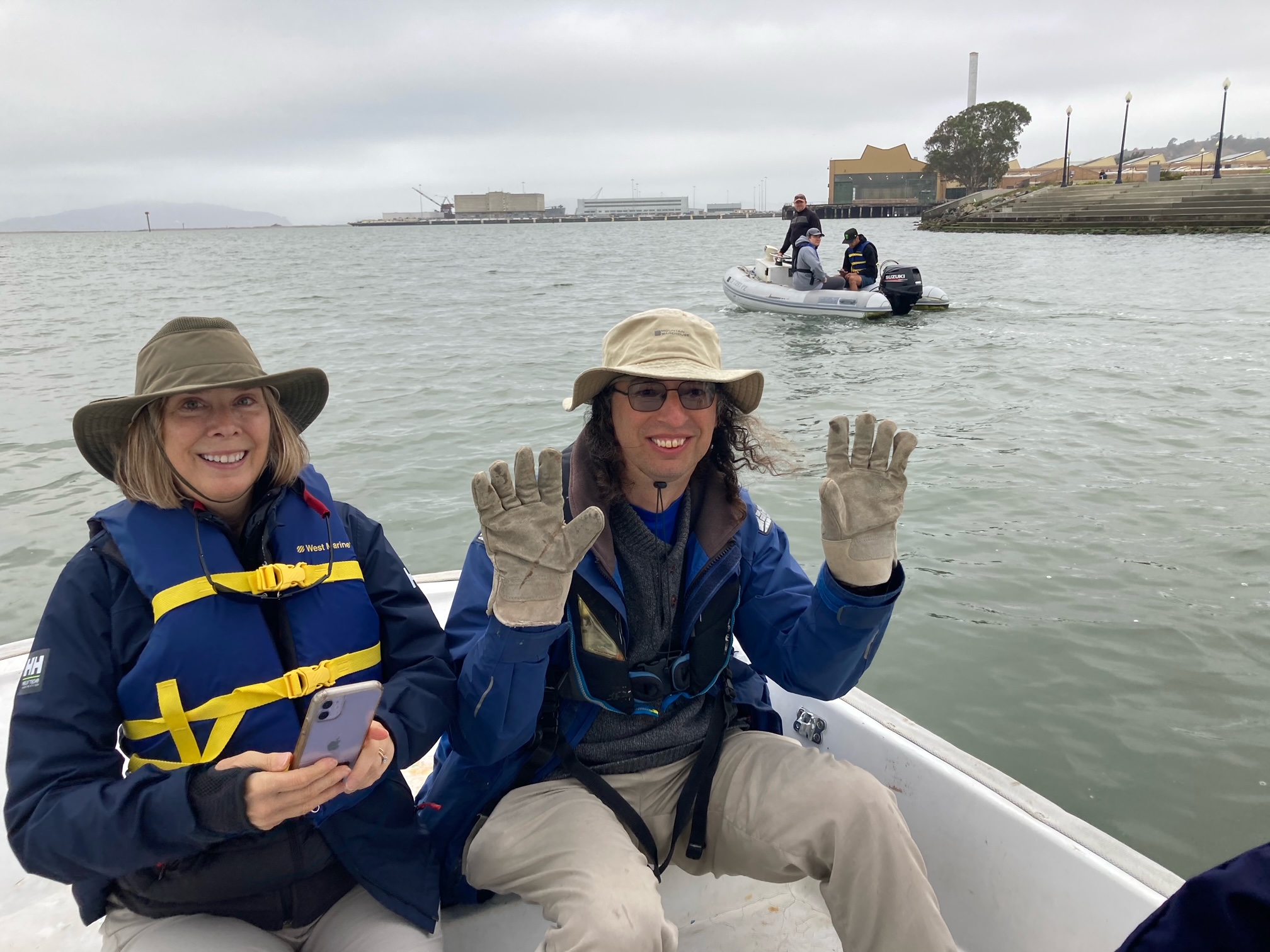
On a cold September morning, a rag tag team of dedicated TWSC sailors and their friends gathered at the Richmond Marina Dock G where we met Matt and proceeded to the island on a zodiac and two motorboats from TWSC.
A light breeze from the Golden Gate made the air crisp and enjoyable, waking up all remaining sleepy heads who did not have their daily dose of caffeine. Thanks to careful planning by Matt, the Tide Gods were on our side this time around allowing us to pass the treacherous shallows as we approached the island dock. Timing is everything and if you don’t pay homage to them, you will run aground and wait until They decide to let you go… if they decide favorably that is.
The island is a bird sanctuary and a breeding ground for many species of birds migrating between North and South coastal territories. Based on Archaeological excavation the island was inhabited by Coastal Native Tribes as early as 3000 B.C.
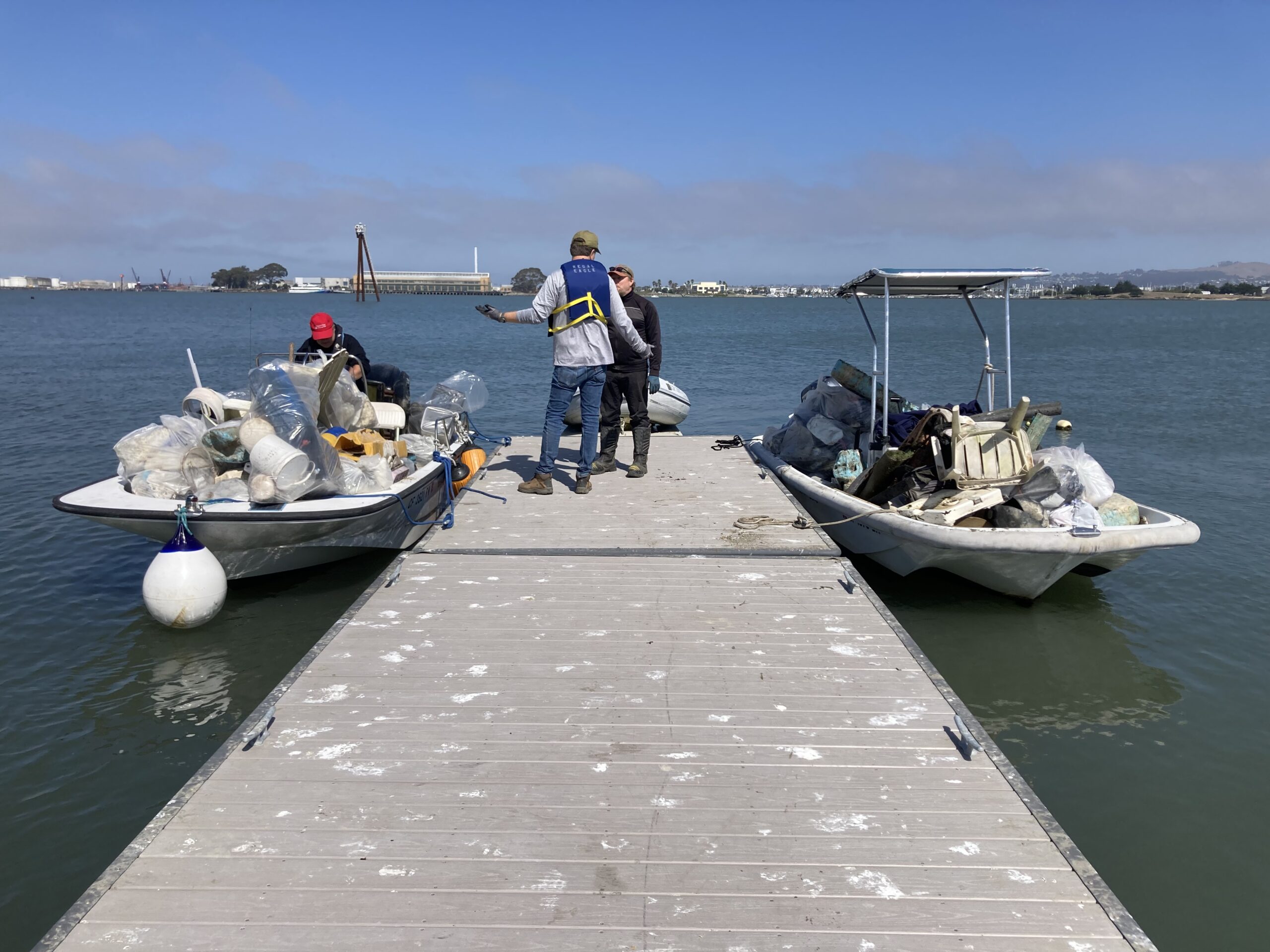
Our group of volunteers were determined to make a difference and clean up the accumulated plastic debris making this swath of land a safer, cleaner place for all its inhabitants. Due to tidal range, we only had a few hours on the island to do our job before low tide settled in for the next 6 hours. By the early afternoon we had removed approximately 30 large 60-gallon bags of plastic trash and debris from the island. Due to Brooks Island location and prevailing winds on the San Francisco Bay, all floating trash generated by people usually ends up here on the shore. It’s a never-ending struggle to keep the island beachhead plastic free, but there are those that will take on the challenge annually.
So, what did it take to make this endeavor happen… a thought.
A few years back Tony had a thought, an idea; he turned this idea into an organized plan with the help of Matt and the good folks at REPS and TWSC, there was no shortage of folks wanting to volunteer and participate in the plan to make a difference, myself included.
Over the four years Brooks Island beachhead has turned around from a place filled with floated garbage to a local jewel, a quiet beautiful quaint beach nestled in the busy San Francisco Bay.
So, what’s in it for me you ask…
For me, the next time I teach my students tacks, jibes reefing sails, COB’s maneuvers next to Brooks, the ever so pungent smell of bird poop from the windward side will remind me that I was part of a greater difference, which allowed birds and nature to return and flourish, making the San Francisco Bay that much nicer to sail and enjoy as a sailor…and the smell, well you get used to it after a while. 😊
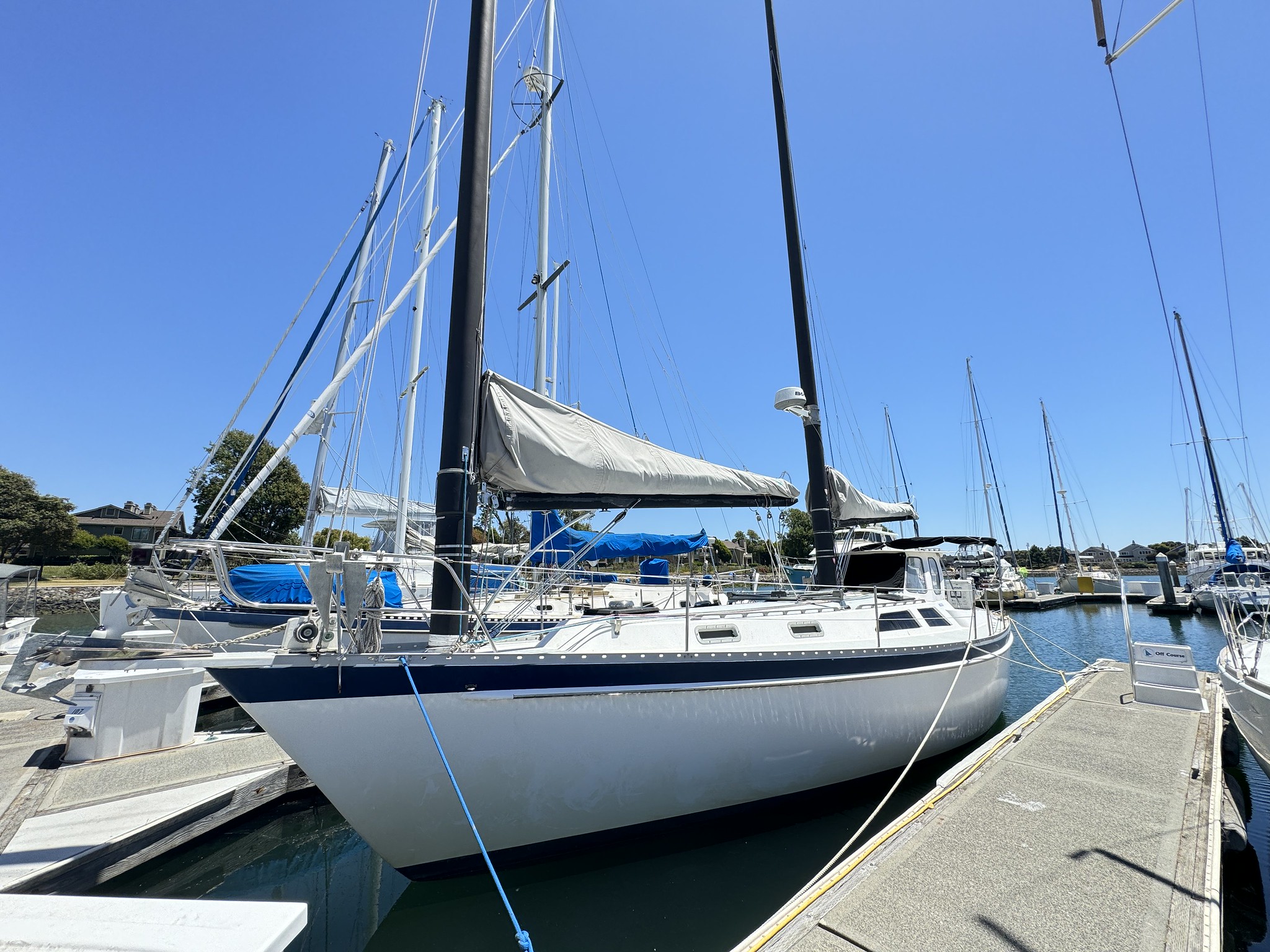
Since Odyssey joined the Fleet, I immediately thought: “Nope! That’s just too much boat for me.” From the multiple masts and lack of jib, to the sturdy dodger and the slew of lines in the cockpit, it seemed beyond my capacity. On top of that, I had heard and seen a few instances where getting into the slip was a challenge. Naturally, because that’s how the universe works, I found myself on the schedule to teach its next checkout. So, I reached out to the owner and fellow instructor, Carlos, for a private checkout of my own. And, let me tell you, it was nothing like I anticipated and a truly wonderful sailing experience.
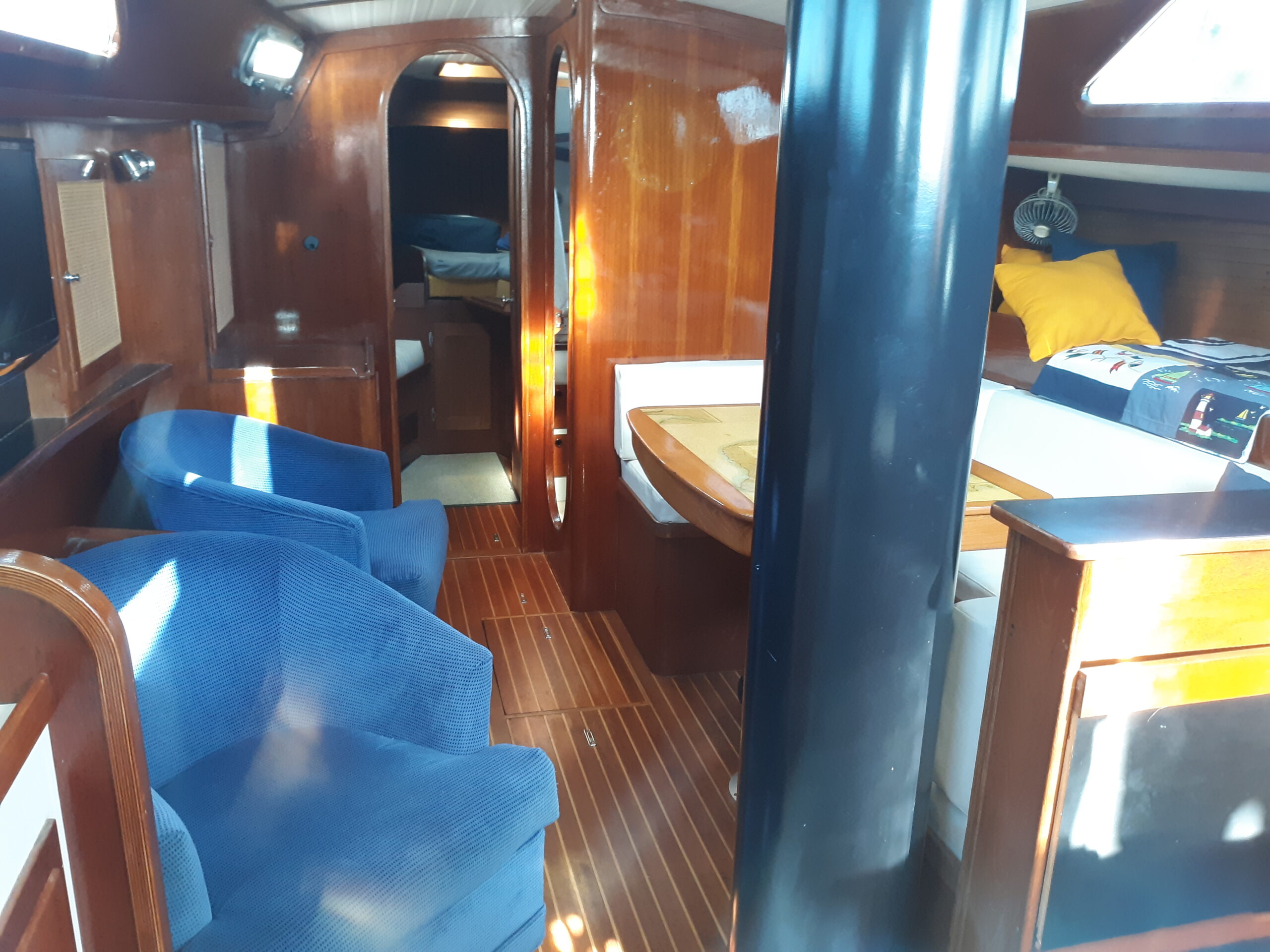
To start, we walked through the checkout sheet together. If you haven’t been below on this 1986 Freedom 39, she is beautifully outfitted with swivel chairs, spacious berths, and a roomie banquet/table. And the engine compartment has easy access from the galley and aft locker.
Once the checkout was complete, I could feel my nerves increase knowing that our slip departure was imminent. With some great tips from Carlos, however, I took us out. Similar to most boats in our fleet in a downwind slip with wind from the southwest — starting on the starboard stern, we worked our way around the boat and cast off our lines, taking the forward spring line to the bow to keep us centered in the slip, and stared out. Now, you might be asking yourself the same question I had which is: “If you start your turn when the mast clears the end of the slip, what do you when you have TWO masts?” Well, the answer is: between them. In fact, a good indicator on the boat is the traveler for the main mast (the forward mast). The traveller for the mizzen mast (aft mast) is when the mainsheet just behind the helm. One important thing to note is that Odyssey is heavy and doesn’t respond quickly under power, so having a little extra throttle to come out of the slip is key. As you clear midships and turn the wheel full to port, you might feel as though she won’t turn. Be patient. She will. And she did!
And now for the best part, the whole reason we all sail…the sailing part! Each sail has two reefs, a halyard, vangs, and a sheet. Pretty standard. So, we approached windy corner and started hoisting. Order of operations? Main first, then mizzen (reverse to drop sails). Now, here is the only slightly challenging part of the charter. It’s a lot of sail and you have to be careful not to get the battens stuck in the lazy jacks as you hoist. However, once they are up and you set them, you get to sit back, relax, and enjoy everyone you pass looking at your vessel in awe. The best part? Tacking is SO EASY! You never have a jib to contend with. And, when it comes to being on a run, with no shrouds, you can easily set yourself wing on wing.
Coming back in was what I had feared the most. As it turns out, it was just like any other docking experience I’ve had. Pro tip: if you need a little help getting the stern to port to line yourself up better coming in, give it a little kick in reverse and the prop will set you up for a perfect landing.
All in all, my experience was nothing like I had anticipated. It was a lot of fun, way easier than I had imagined, and not scary at all. I highly recommend you do a checkout on Odyssey and enjoy this stunning cat-rigged ketch.
There is really no such thing as safe to go; if you want to be safe, don’t go. Said Saint Thomas Aquinas seven centuries ago: “If the highest aim of a captain were to preserve his ship, he would keep it in port forever.” Actually, even that won’t work. And that’s not why we build ships.
Now, of course there are easy sails, many blissfully so. The problem is that in advance, you just don’t know which ones they are. I’ve gotten into terrifying trouble right at Point Potrero, or next to my mooring in Tomales Bay, saved by what I like to flatter myself is seamanship, but equally credited to a benign nod from Poseidon. You’ve chosen to be a sailor, and that means that although safety is a priority, you don’t choose to be safe and comfortable at the expense of a mundane and prosaic existence. You’re willing to take some calculated risks for the sake of adventure and challenge. But if you’re going to seek adventure, it’s a good idea to bring your brain along, just in case.
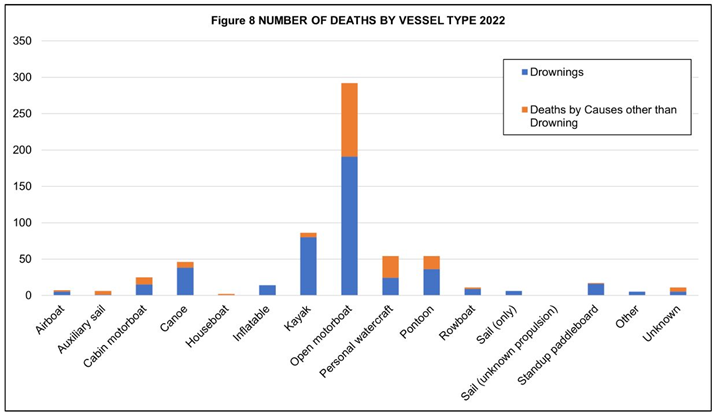
Compared many things we do all the time, sailing is quite safe. You’re many times more likely to have a serious accident driving to the marina than on the boat. And among various types of boating, sailing is among least risky. According to the Coast Guard, canoes are more dangerous:
Nevertheless, the prudent mariner takes nothing for granted with regard to safety. Now I’m not superstitious and do not adhere to the precautions of sailors of yesteryear, like prohibiting bananas or never leaving on a Friday. But still. When I get ready to untie the lines I’m reminded of the great Jerry Rice, who dressed meticulously before entering a football field to do battle and get muddy. If I’m about to go face the sea, an adversary much more formidable than some mere flesh-and-blood competitor, I’m gonna get myself ready.
The best way to be a safe skipper is a bit of a catch-22. You do it by sailing. The more you sail, the better you will be able to manage the boat without becoming overwhelmed when things go all ahoo. Spending time with every seemingly minor detail you are taught by Tradewinds contributes to your being safe to go.
More specifically, Tradewinds requires completing a checklist prior to departure represented by our acronym, “safe to go.” But if you charter elsewhere, you may not have such a list to jog your memory, and that’s when having memorized “safe to go” comes in handy. Many of these are mechanical items, often checked off perfunctorily. But is the skipper safe to go? Does he or she understand how to use all these things quickly in an emergency? Of all the gear on board, nothing is as important to the safety of the boat and crew as the mind of the captain. It’s also the most likely to malfunction.
……………………
S is for safety gear. In over 40,000 miles, I have used few of these; but I’m certainly glad I had them aboard. As Brandy’s dad Butch, a great sailor, is fond of saying in a phrase worthy of Captain Ron, “It’s not a problem until it’s a problem.”
We are required by the Coast Guard to have certain gear. In addition to those sensible items, the competent skipper will check the boarding ladder, first aid kit, wooden plugs, radio, anchor, boat hook, extra lines, charts and the tools to use them, and compass. It is not sufficient to merely check a piece of gear off the list. You need to be able to clearly explain it to your crew when things get dodgy and your mind is flopping around like a wounded snake. Panic in the face of the skipper is not a look that inspires confidence. Two examples of things you should inspect, in case their deployment is not as obvious as you may assume, are the main anchor and the emergency tiller, so be sure to familiarize yourself with these. When things go pear-shaped, these will have to be deployed without hesitation. That is not the time to be figuring out how they work.
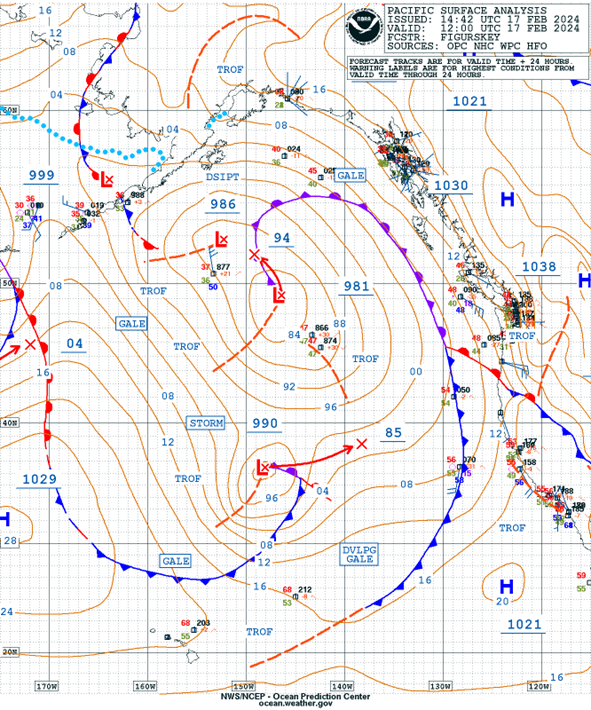
A is for atmosphere. In San Francisco Bay we have two major weather patterns, summer and winter. Fall and Spring are a mix of the two. It’s easy enough to check the weather for any given day, but knowing the reasons behind the weather in the forecast may help visualize what is happening and respond to predictions. This can be confusing with regard to a small craft advisory. In the summer, our prevailing wind in the Bay is caused by the heating of the Central Valley, which creates a thermal low when hot air rises after the ground heats up in the afternoon. This sucks air through the Golden Gate, the only gap from the ocean through the coastal mountains, and into “the slot,” and when this is strong it triggers a small craft advisory. In the summer, while the breeze at the city front may be in the mid-twenties, you may see only ten knots in the Oakland Estuary which is hidden from the venturi around the Golden Gate. The great thing about this is that in the summer, you can pick your conditions. Not so in winter, when the Central Valley doesn’t get hot. The weather we see will be part of the larger, synoptic pattern, so the results are not so easily managed. In the map below you see a front extending from Alaska to Mexico, which will bring wind and rain to the entire Bay as it heads east. There will be no escaping to Oakland; the small craft advisory will pertain to the entire area.
If you charter abroad, your charter company will almost certainly help you with local weather. If you cruise privately, however, you’re left to your own devices. You should learn how to read a weather chart like the one below. If you have Starlink, these can be viewed online but if you don’t, there are other ways to do it. You may have to rely on local VHF weather, which may be in a foreign language. You’ll have to do some homework on your alternatives in each area.
F is for floorboards. This means checking automatic and manual bilge pumps, and locating each thru-hull valve so that you can find them in the dark. I don’t wish to alarm you, or maybe I do, but if one of these is left open and the hose somehow fails, you need to check them all immediately. If enough time has passed so that there is water in the boat submerging the valves, you won’t be able to see them and it will take too much time to try to figure out all the locations by looking at the manual. You need to have a map of them in your mind before you leave the slip. All but the valves for engine cooling, and for the packing gland if fitted, should be closed when underway and not in use.
E is for engine and here I also include electrical. Do your engine checks, safely disconnect shore power, and make sure the VHF is on and set on channel 16. A cautious skipper will inform his crew, briefly, how to use the radio in an emergency in case the captain is injured or occupied. Nowadays, the Coast Guard may ask for a mobile number to continue a call. This gives you the advantage of being able to move around the boat and attend to things instead of being stuck by the VHF.
T is for tides and currents. Know how to use the tide book to adjust tide time and height for Richmond, or for where you plan to sail, particularly if this is to shallow Richardson Bay, Ayala Cove, or Clipper Cove. Adjustments are found at the beginning of the tide book, on pp. 11-13 in the current edition. For currents, check pp. 50 and following for min-charts of the bay. These show, graphically, the flow of the current for every hour during the tidal cycle. You need to be familiar with using a tide book, even if the app on your phone is your preferred method. The way our book works is the same way they work in French Polynesia and the Mediterranean. If you have no Internet, the book is your fail-safe.
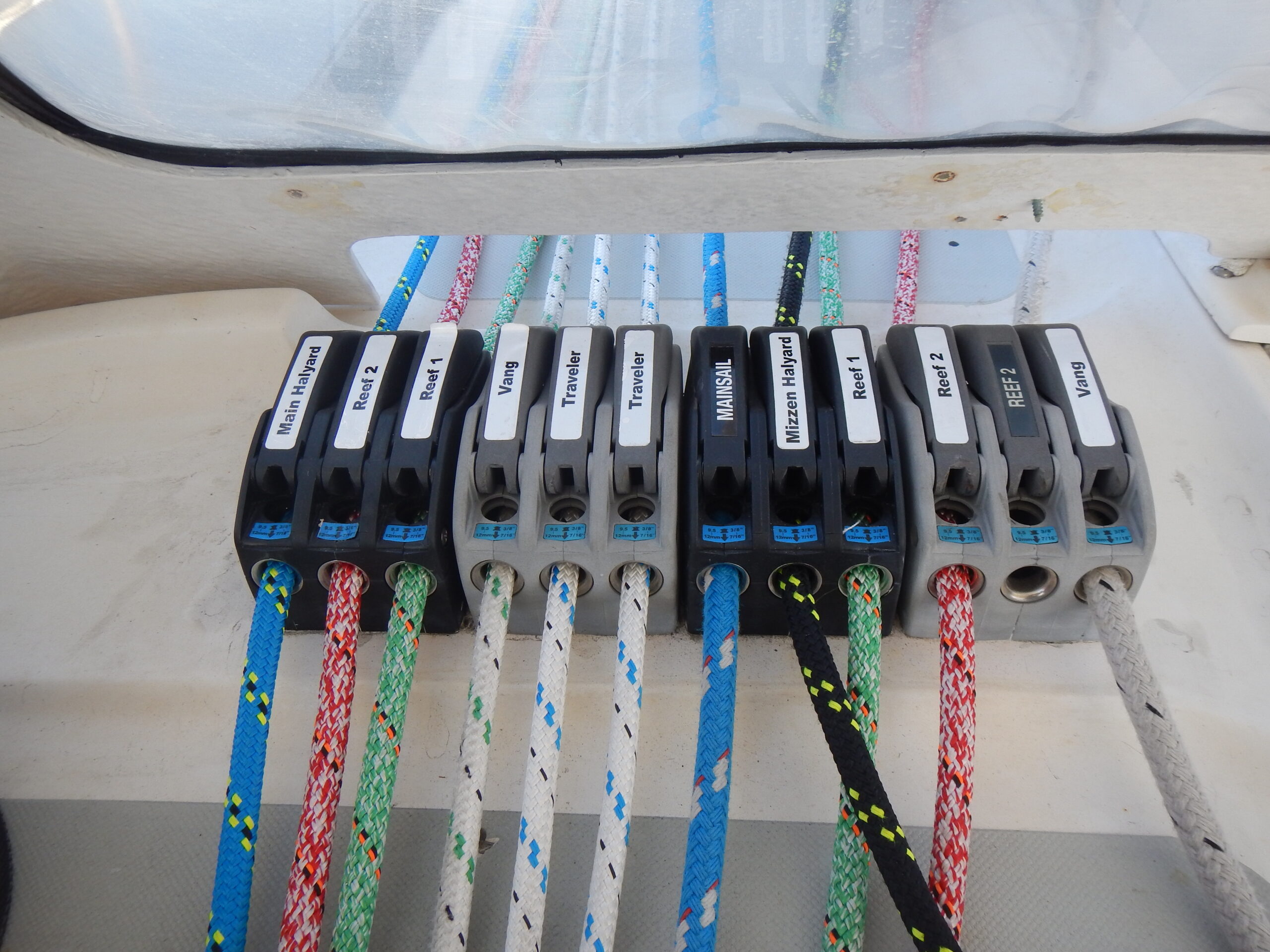
O is for on-deck rigging. Make sure you know which lines are which, particularly the reefing arrangement. At least one person besides the helmsman will be required for this procedure, so make sure your crew understands the lines, and that you understand them well enough to describe the procedure step-by-step to crew if you need to stay at the helm.
G Check the fuel level.
O Check the steering, and find the emergency tiller. Don’t just locate it; install it. They are all a bit different and some are counter-intuitive. On Papagayo, for example, the tiller is reversed, so you’ll have to steer backwards from what you’re used to. Try to avoid putting yourself in a situation where you have to back up the boat using this arrangement, as with a truncated tiller you won’t have the necessary leverage to control the rudder.
Being safe to go isn’t just about mechanically checking off these boxes. It is centered in the knowledge of the skipper, who is satisfied that all the necessary preparations to keep the boat and crew safe have been attended to. The confidence that results will be clear to guests, and will give more comfort to those unfamiliar with boats. The lack of confidence that comes from a hasty and ill-planned departure will also be recognized by them. They will not be put at ease by it.
In the footsteps of Don Gilzean, Craig Walker, and Tony Johnson, I’m stepping up to share some important tips as we see the need from our clubhouse vantage point. And the biggest thing we’ve noticed lately involves…furling!
So, let’s start at the beginning. Letting out your jib (OR furling main). The key to both is back-pressure or “tailing” of the furling line as you ease out the sails, but let’s go back a little further.
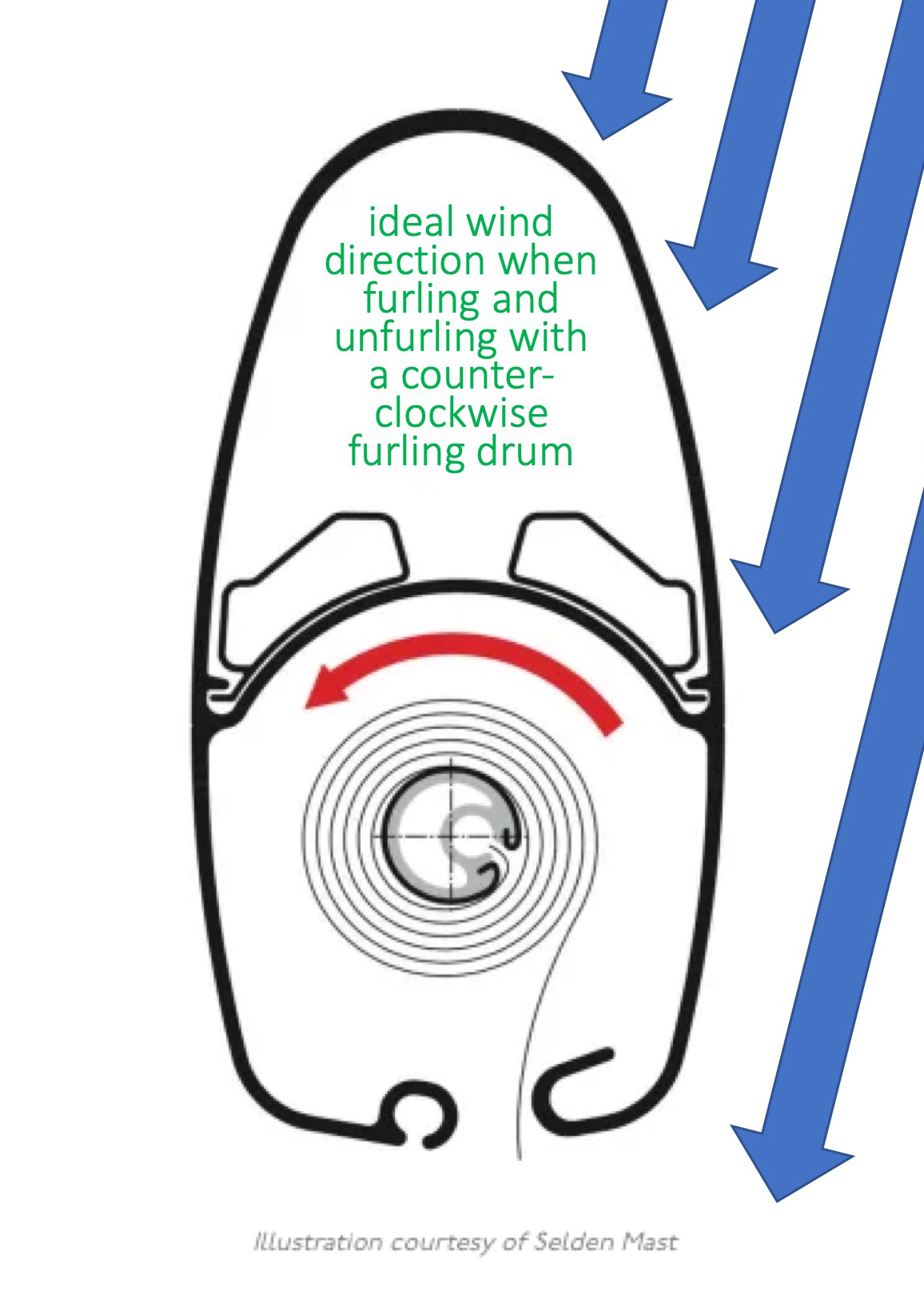
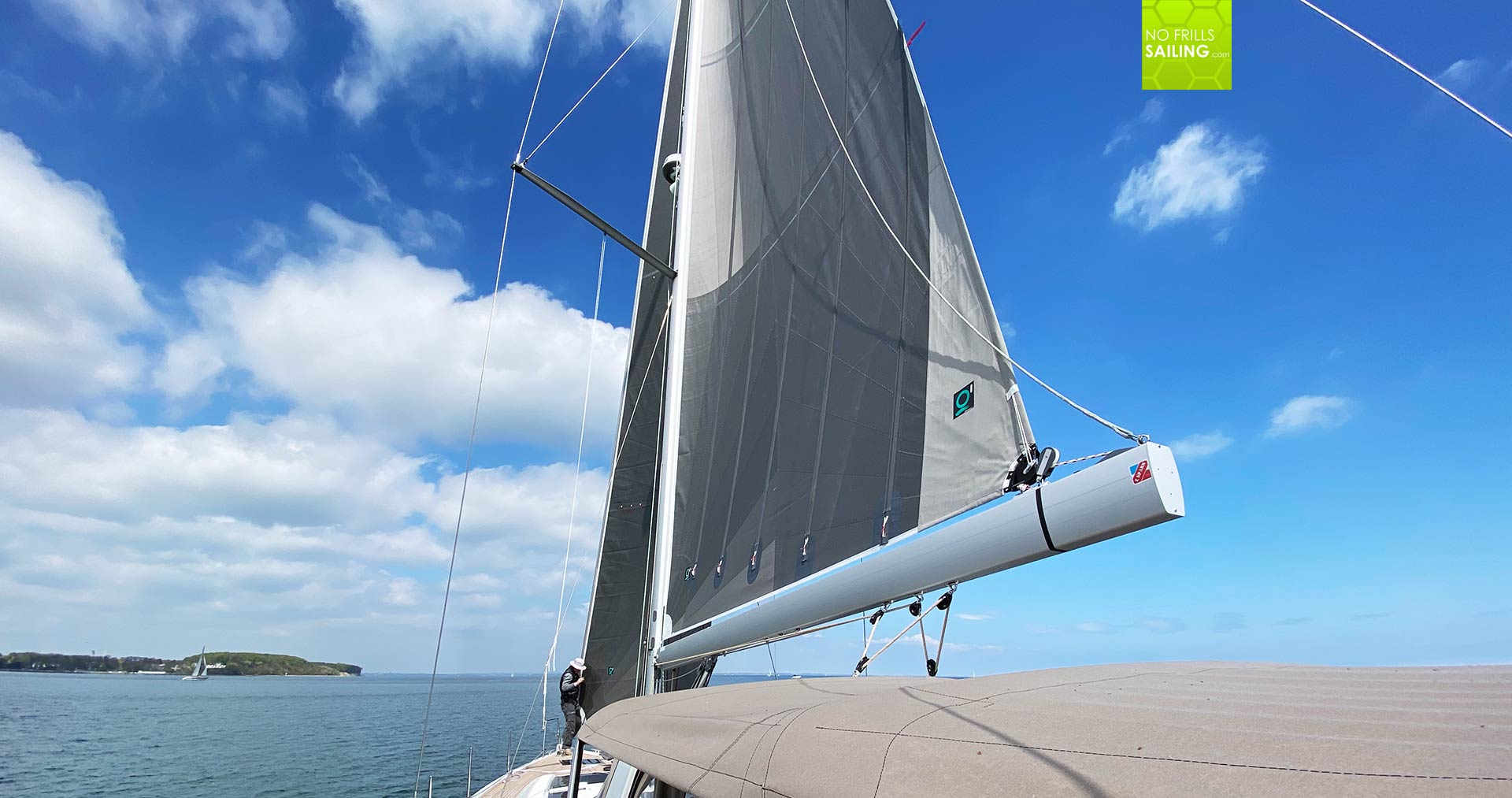
Unfurling the Main: You’re head to the wind, you have your boom vang released completely, you have some slack in the main, and you’re ready to start pulling on that outhaul. Right? Wrong. Most furling mains (you should always check) wrap counterclockwise in the mast (see image below), so the best angle to the wind is a few degrees to port to let the wind help the main out. The other equally important component is the backpressure/tailing mentioned before. As you are pulling on the outhaul, have someone else apply just a little tension on the inhaul. That way, the main won’t come loose in the mast and get stuck, which is never fun. Doing it this way should be easy to do by hand – no winches! Never force a stuck sail by grinding away on a winch.
Furling the Main: reverse the above, but with one difference. This time, look at the sail and put equal tension on the foot and the leech. If one of them is looser than the other, the sail will have wrinkles in it while it is rolling into the mast. Adjust the boom vang or mainsheet as needed to keep equal tension on them.
And now the Jib! What we see and hear consistently is that you have to get your main and jib out at the same time, head to wind, to sail. Not true! There’s a classic saying in sailing that goes, “Raise sails aft to forward, dowse them opposite.” Get your main up, bear away ideally to a beam reach, and then let your jib out. The wind will help, and you won’t be too overpowered – as you might be on a close haul.
The key thing to remember here, again, is tailing/back pressure on the furling fine as you pull on the working jib sheet. This may involve finding something to wrap it on, like a cleat, so that the pressure doesn’t pull it from your grasp (or burn the hands of your crew!)
Lastly…furling the Jib: often, the response to the steps of jib furling is “head to wind.” But, if you head into a good, stiff, summer breeze to furl the jib it will take the wind pressure off, but it will also turn into a flag and flog relentlessly. When the jib is flogging, we are reducing its life. Jib sheets are also flogging and can break dodger windows, are hard on blocks & rigging, and are a danger to crew. Instead, head down-wind, almost on a run. Have you ever tried to steer downwind and found yourself heading back up to keep your jib from collapsing? This is because the main is “blanketing” the jib from the wind. On this point of sail, you’ll be able to furl the jib with very little effort.
And now, reverse the tailing process – applying back pressure on the working jib sheet while pulling on the furling line!
So, can we answer the question in the title of this post? I think so. 😊
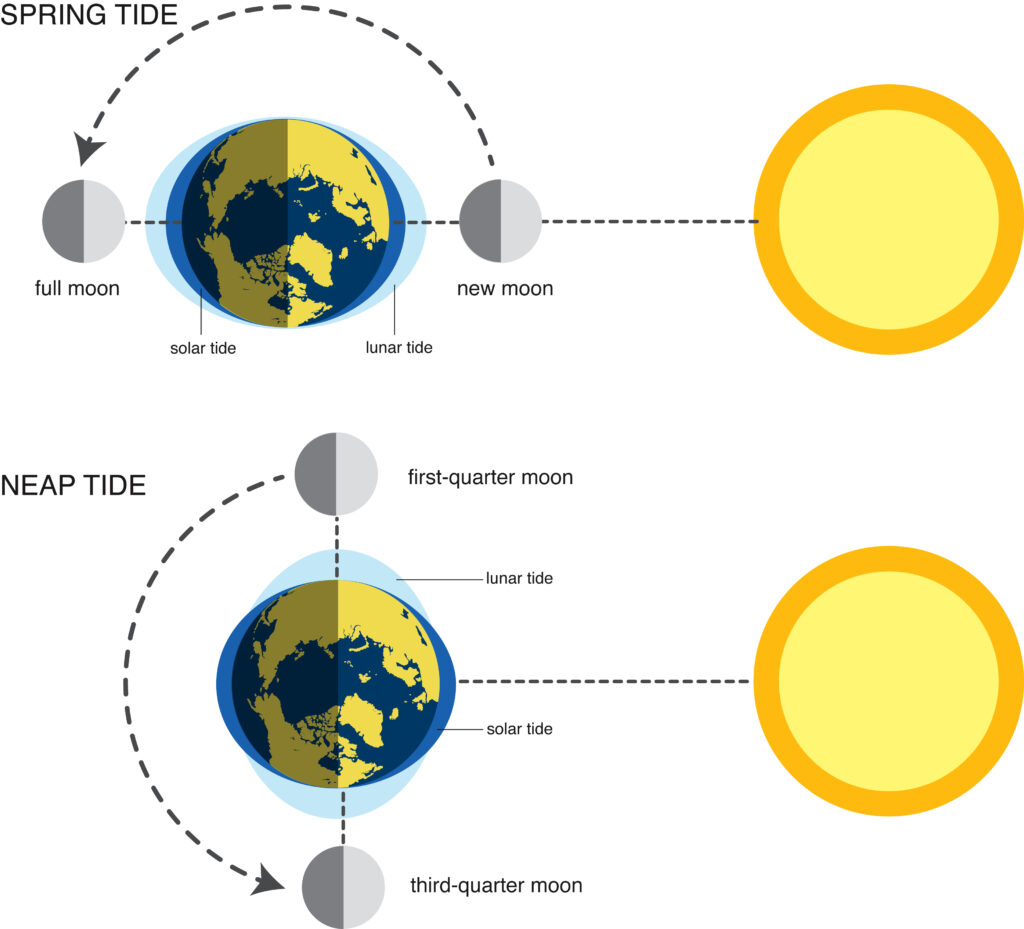
In the left column of the daily pages in your tide book, you’ll see the phases of the Moon, and in the columns to the right of a full and new Moon, you’ll see that some of the heights are in bold, since they are higher than average and called “spring” tides. When the Sun and Moon and Earth are aligned in either a new or full Moon, the gravities of the first two can be thought of as additive, and spring tides result. When the Moon is perpendicular to a line between Earth and Sun at a waning half-Moon (the left side is bright), or waxing half-Moon (the right side is bright), we have “neap” tides, which are lower than average.
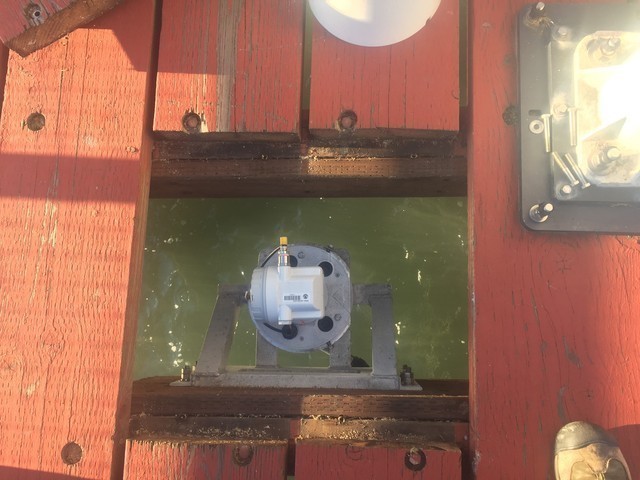
Tidal heights are measured relative to a refence sea level or tidal “datum,” which is mean lower low water. This datum is determined by empirical observation of the tides over a period of nineteen years at, for example, Tide Station Golden Gate, the oldest continually operating tide station in the western hemisphere. This is called a tidal epoch.
Golden Gate tidal gauge
But why nineteen years? This video shows some of the complications of the Moon’s orbit. It’s an ellipse and is tilted approximately 5° to the plane of the ecliptic, while the Earth itself is tilted 23.5°. In addition, the line of the apsides, which is the line between the Moon’s perigee (closest point) and apogee (farthest point), rotates around the Earth in a period of 8.85 years, which is called the “precession of the apsides.” The plane of the orbit also wobbles, like a plate settling on a table, in a retrograde direction every 18.6 years. This is called the “regression of the nodes.” These variations in the Moon’s orbit change the Moon’s effect on tides, which is why NOAA uses a “mean” or average height of tide over nineteen years to enable a steady reference. (The Greeks noticed a similar but not directly related period of the Moon’s orbit, discovered by Athenian Meton in the 5th century BC, and so called the Metonic cycle. Babylonians, Polynesians, and native Americans observed this, too.)
The Earth’s seasons occur because although the Earth’s tilt doesn’t change as it orbits (or only over a period of 26,000 years, which we can ignore), it either tilts at 23.5° towards the Sun in northern hemisphere summer, or away from it in northern hemisphere winter, and this affects the amount of gravity the Sun directly exerts in different parts of the globe. The Earth’s orbit around the Sun is also an ellipse and has similar precessions as the Moon, but in addition is affected by the gravity of the planets. The speed of both the Moon and Earth vary throughout their orbits, as was discovered by Kepler.
There are even more variables to the relationship between Earth, Moon, and Sun, and tides, and if this is starting to get a bit dizzying, don’t feel bad. No less an authority than Sir Isaac Newton said that contemplating the Moon’s orbit gave him a headache. Writing a century before Newton, Galileo did not believe the Moon could affect the tides at all, despite centuries of mariners noticing the conjunction of tides and phases of the Moon. This was because, like Einstein with regard to quantum entanglement, the idea that a distant object could affect the Earth struck him as something akin to witchcraft. To be fair to Galileo, even though we understand what gravity does, we still don’t understand what it is. But tell you what, let’s leave that one alone.
Here is a fun fact that is the result of relationships between orbit of the Earth and Moon: When you see a waning half-Moon, the Earth will be where the Moon is in about three and a half hours—but it will be gone, so don’t worry. Here’s why: The orbit of the Earth is an ellipse, but let’s not be fancy and call the distance to the Sun from Earth about 93 million miles. The diameter of the Earth’s orbit is double that, or 186 million miles, and multiplying by pi we get the circumference, which is 584,040,000 miles. The year takes 365 days, so dividing by 365 we get 1,600,109 miles per day, and dividing that by 24 we see that the speed of the Earth around the Sun is 66,671 miles per hour. Average Earth-Moon distance is 238,900 miles. The Moon orbits the Earth counterclockwise, in the same direction that the Earth orbits the Sun, and when it is ahead of the Earth in the earth’s orbital path, you’ll see the left half illuminated. It will be visible from about midnight to noon. We divide the Moon’s distance by the speed of the Earth, and get approximately three and a half hours to get to the moon’s location at the earth’s speed.
We’ve just scratched the surface of all the things affecting tides. For example, on a new Moon when both Sun and Moon are on the same side of the Earth, why do we still have two tides, instead of one big one? Why, under the same Moon and Sun, does the Bay of Fundy have tides of over fifty feet while Tahiti has about one? What is a seiche? The boffins at NOAA’s National Ocean Service earn their pay by figuring this stuff out in intricate detail. If questions like this intrigue you but you aren’t fond of knotty math, check out Beyond the Moon.
by Jeffrey Hare, Instructor and Owner of Emerald Sea
This 3rd post in our series will cover a topic of keen interest to sailors; Places to stop and what to see and do between San Francisco and San Diego (will cover Mexican ports in future entries). There are plenty of weather applications and advice out there, so I will cover only what we observed when traveling south in late November of 2023, and again North in June of 2024. With the proper ASA skills learned prior to venturing out to these ports of call these destinations will be a great adventure! You should have taken ASA 106 at least and I highly recommend Advanced Anchoring and Docking, Weather, Costal Navigation, in addition to some offshore time as crew prior to making the trip on your own. I am partial to Cruising Catamaran as there are only 5 classes for 2024 – book yours today!
General observations and advice: California Marinas have a fairly high occupancy rate, so don’t expect to get a slip upon sailing up to their front door. Call ahead and reserve a slip as soon as you have a solid itinerary. The Marina will likely want a non-refundable deposit, or possibly the entire amount for your stay whether you show up on time or not. It is perfectly normal to be charged for the length of your boat by the foot, or the length of the available slip your boat fits in, whichever is larger (if you have a 45 foot boat and only a 50 foot slip is available, you will probably be charged the 50 foot fee). For transient boaters electricity and water is included and unlimited – it is nice to have a little electric heat when spending a few nights at chilly California locations.
Some marinas have a generous, calm, and comfortable anchorage area (first come first served and can not be reserved) – this is true with Pillar Point, but not true with Monterrey even though charts show a large open space at both. If your vessel is equipped with a tender, kayak, or stand up paddle-board, it is actually a lot of fun to utilize these tools to get to shore for dining, shopping, or hiking. Most marinas will have a dingy dock available for a nominal fee – docking at restaurants is typically free if you patronize them. You can also pull up on the beach and mostly people will leave your boat alone – just like a car in a parking lot, don’t leave anything of value in sight and easy to grab in your boat. If you beach your dingy, be aware of the tides and pull them up off the beach accordingly – If you have a heavy dingy with a heavy motor this might pose a problem when you need to drag it all back to the water so be careful.
The top photo above shows the nice breakwater and what looks like a generous anchorage area at Monterrey Bay. Combining this with other applications like Google Earth in the lower photo, you get to see all of the boats that nearly fill that area, and get the sense that this might not be an anchor area at all!
Other advice I would give is taking advantage of advice from people who have sailed to these ports before, and also using your smart device (mine is an iPad) with Google Earth to observe any obstructions (temporary obstructions such as boats and fish traps still need to be on the forefront of your on-watch crew).
Speaking of on-watch crew – I have two crew members forward with one focusing on the Starboard side and another looking only at the Port side of the boat with practiced hand signals, this is done any time entering a confined space. These Crew members are not just watching distance from the sea wall and rock obstructions, but anything that might foul the propellor – fish traps, loose fenders, and even stray kite string! Occasionally there might even be an improperly lit (or unlit) boat in your path – the more eyes-on the better.
The southern ship traffic lanes are very busy 24 hours per day – the photo here of my Radar and AIS showing a huge amount of traffic on the night of November 20, 2023 as we exited the bay. Emerald Sea felt like a target, especially since one of the vessels is called “Target” and their heading seems right at us! Never let your guard down and use all instrumentation available – a short time after the top photo was taken, another batch of vessels came into view including the cruise ship “Crown Princess”! At this time, another Tradewinds Instructor (you know who you are) was aboard and I think may have been at the helm! As a quick-quiz, I believe there is a COLREG about deck lights not obfuscating navigation lights (which rule is this?) – apparently this does not apply to Cruise Ships as seen in the 3rd photo.
Shelter Cove:
Some charts will show an anchor area at Shelter Cove, just south of Pacifica and outside of Pacific State Beach. While this anchorage area offers good holding ground I don’t like it due to risk of getting kelp wrapped in your propeller and exposure to surf. It is probably a good place to dive for a few hours but I would not personally trust it overnight.
Pillar Point / Half Moon Bay:
Traveling south all sailors should be aware of the Pillar Point Marina at Half Moon Bay – a favorite destination for the ASA 106 Offshore Passagemaking class. The marina gets very busy on the weekends with sailors taking a few days to visit this nearby locale, but the large and expansive anchorage area offers plenty of room to anchor if the marina gets full. Use all of your ASA skills (especially your Radar class if trying to get there on a Friday night) prior to venturing here and I recommend only approaching during daylight as there are hazards to the entrance.
Reference your chart upon approach – have your crew help you identify the Safe Water Mark as well as Buoys 1, 2, and 3 while you approach the entrance – you do not want to cut corners here. The gap in the breakwater is very narrow and this is when I typically have crew on the bow calling distance to each side.
Half Moon Bay offers a wide variety of wonderful dining experiences, groceries and supplies, boat parts, and many things to see. Because of the large breakwater this area is safe in any weather and offers an excellent resting spot whether running south or north. Highly recommended by the crew of Emerald Sea.
When going south: Stop here if your crew is new to offshore cruising / If anybody just needs a rest, shows any sign of seasickness, or just to rest. It is a perfectly save area either at anchor or in the marina.
When going north: If you have the extra day, I think it is nice to arrive in San Francisco Bay Refreshed, clean and rested. This is the perfect stop to do that.
Santa Cruz Anchorage and Santa Cruz Small Craft Marina:
While this area offers protection from north winds, it has absolutely nothing to offer to protect your vessel from ocean surf – I do not recommend this anchorage. I am sure it is fine for a lunch break or to take a few hours to paddle board or kayak, even the beach landing is hazardous due to high surf – should only be attempted in very calm conditions. I have friends who anchored here overnight and were miserable not just to the relentless waves, but also the all-night music coming from the bars on shore.
As for the marina, this is the most compact and congested marina I have ever visited. Santa Cruz offers great dining experiences – you had better call far in advance to try to get a place to dock. For any boats over 35 feet I don’t personally recommend it.
Capitola Beach at Soquel Cove:
Similar to my comments about Santa Cruz Anchorage, there is little protection here from wind or surf. If you have a way to get to shore this location offers shopping and dining experiences but I would not recommend an overnight stop.
Moss Landing:
This area offers protection from any weather condition and consists of several marina areas. You have a better chance of getting a slip here, as long as you call ahead, than you do in Monterrey. There is no designated anchor area. The marina offers everything needed including a fuel dock and plenty of room to maneuver…. While the entrance is wide open this area is very popular for fishing – you need to be on the lookout for rogue fishing apparatus on approach.
Monterey Bay — Breakwater Cove, Municipal Marina, and General Anchorage Area:
The first point to make here is that if you intend to proceed south, I highly recommend at least an overnight stop here for the Skipper and crew to rest. If you manage to get a slip in either marina the crew should shower, have a couple of nice meals out, take a nice long walk, and get at least one good nights sleep (more if you are not used to overnight passages). My own policy is to make sure there is a two-day weather forecast that you really like as the following stretch will be the longest without anywhere to go/do/stop. If not done already, this is where the Skipper should establish the watch schedule to impose upon departing. With a minimum of 3 crew members, I like a 4 hour shift on the helm, followed by a 4 hour shift on watch (see ColRegs rule #5), which subsequently allows for a 4 hour period of sleep. This schedule allows each crew member 8 hours of rest in a 24 hour period. When on watch they can relieve the helm when needed while being aware of current conditions. Nuff said about my watch schedule – back to Monterey Bay….
All services are available here including boat yard and fuel dock.
If you have not reserved a slip and/or they don’t have room for you inside the breakwater, the General Anchorage area is clearly marked just to the north of the breakwater. I have anchored here and it can be rolly as it offers little or no protection from wind or surf. Anchor well with plenty of rode while you also pay attention to the tide and weather forecast. This area is good to either wait until there is room at the marina or the weather forecast clears for a minimum of two days and you just go. This is a nice sandy bottom and good holding.
Going South: Depending on your boat speed it is something between 10 and 20 hours to the next stop of Morrow Bay. You should (at a minimum) stop here or have stopped at Half Moon Bay so the crew can rest and prepare.
Going North: If after sailing upwind from Morrow Bay, this is a great place to celebrate your accomplishment and let the weather settle for your next leg to Half Moon Bay or even San Francisco Bay.
Stillwater Cove at Pebble Beach:
This is just a couple hours around the corner from Monterey. While a legitimate anchor area, I don’t recommend this due to the rock hazards at the entrance. It does offer good protection if a storm from the North blows up, and some protection from westerly winds and surf, do your best to skip this and move along. I consider this a last-resort place to weather a storm. If going North, do your best to continue to Monterey – it’s close. If going South – stop here only if some storm took you by surprise.
Wreck Beach:
Another last-resort anchorage area. This has good holding ground but does not offer much of protection against anything. Use only in case of emergency. Remember: It’s named “Wreck Beach” for a reason. Avoid if possible.
The only reasonable stopping point between Monterey Bay and Half Moon Bay — San Simeon Bay:
This anchor area offers good holding and protection from both North and Western weather. It is not very big – comfortable for maybe 5 boats with swing area, so be careful. Very helpful if you are exhausted and just can not making if going south, or if you are going north and want to sneak ahead another 20 miles (north of Morrow Bay) to make sure a short weather window or uncertain weather report is something you want to tackle. While there is no fuel, there is a restaurant and general groceries here if you can get to shore with a dingy/kayak/SUP.
Going North: Use this if the weather is stronger if you want it to be and don’t want to have to return that 20 mile investment from Morrow Bay.
Going South: Unless a storm comes up, just power through and continue on to Morrow Bay if you can. All your supplies are there and protection from any storm.
Morrow Bay:
I recommend stopping here either Northbound or Southbound as you should celebrate your accomplishments and prepare for the next milestone in your journey. There is no haulout and very little in terms of marina space, there is plenty of both mooring balls and anchor areas as long as you can get your tender/Kayak/SUP to the many dingy docks. I waited here several days on a northbound journey and serviced the engines and sail drives as all of the supplies needed are here. The dining options are plentiful, there are several Auto parts stores within a short walk, and plenty of things to see. Enjoy this time to take nice long walks and stretch your legs!
Going South: Keep a keen eye on the weather around Point Conception. The wind and surf can both get high but you only need a 12 hour window. Don’t mess with the weather – this is a very serous section of the coast (I promise weather paradise once you get south of Point Conception. Keep your eyes peeled for a Starlink Launch from the nearby Space Force base at Vandenberg – quite spectacular but is over quite quickly…
Going North: This is where you will want to wait for good weather for what may be a 20 hour northward bash. Remember the prevailing winds blow north to south, so the entire western coast northward is called “The Baja Bash” for good reason. You will be motoring, so wait for a 24 to 36 hour weather window before moving on. There is plenty here to keep you occupied and this area provides some of the best protection against nearly any weather.
Point Conception:
This is not an anchor area, or a safe refuge. Instead to the sailor it is more of a phenomena. The prevailing north-to-south costal winds are concentrated on this land mass that sticks out into the sea. Check the condition of the 46218 weather Buoy (https://www.ndbc.noaa.gov/station_page.php?station=46218) before rounding either from the north or south. Be extremely cautious here.
Cojo Anchorage: This is located on charts just south of “Government Point”. It is not recommended unless there is an emergency or you just need to wait out the weather for a few hours without having to backtrack. There are some Coast Guard mooring buoys here also.
Going south: Once you have rounded Point Conception you enter a very large area of Southern California that will feel like a sailors paradise. Point conception does a great job of blocking strong winds and surf from here to San Diego and if you enjoy a fairly constant 10 knots of wind, knock yourself out. I recommend only a few days on Catalina on a mooring ball to celebrate how far you have come so far.
Going North: Use this anchorage again if you don’t want to back-track and just need to wait a few hours for the heavy waves and wind to settle down. I don’t recommend this for an overnight stay
Between Point Conception and Mission Bay:
There are hundreds of places to stop and enjoy as this is considered by everyone in Southern California to be the best sailing grounds anywhere (we in San Francisco Bay disagree). It’s calm, little surf, so enjoy as long as you like. Enjoy the Channel Islands, many marinas and ports of call. I typically have an agenda so after staying a day or so in Catalina, head straight to San Diego. When your direction of sail permits, this is the perfect time to deploy your spinnaker if you have one.
Channel Island Harbor and Marina:
I take it back. This harbor is a great stopping point to take on water and a rest. It is wide open and offers many services. The only caution is to watch for kelp in the area as I have had to dive the propeller to get it off!!!
Mission Bay Mariners Village and Marina Village. This area is far inland and protected from any weather, not that they get much in this area of Southern California. There is both an anchor area (the bottom seems clay and it was difficult for me to set my anchor here), and several large marinas both before and after the bridges. The marinas are sometimes not very friendly to transients but be persistent If you want to stay. There are some good dining options here.
San Diego Bay:
Marinas: There are many – 4 are even “Safe Harbor” marinas who share management with our own Marina Bay Yacht Harbor. The marinas closer to the city are very busy, more expensive, and full, so I recommend checking for slip-space with the marinas further away, such as the Chula Vista Marina, otherwise known as Safe Harbor Chula Vista – we have stayed here several days and there are all the needed facilities including a West Marine within walking distance.
Anchoring: Because most of San Diego Bay is a military security zone, you can’t just anchor anywhere for as long as you like. Checking on your charts, there are several designated anchorage areas starting with “The Shelter Island Yacht Basin Anchorage area A-1, through “The Glorietta Bay Anchorage Area A-5” (and probably some others – photo above was taken December 4, 2023 at the Glorietta anchorage looking toward the Hotel Del Coronado). Outside the bay, only the Zuniga Shoal, just off the North Island Naval Air Station runway, is unlimited and unreserved. This is somewhat protected but you feel a little exposed compared to being in the nice secure bay.
Written by Jeff Hare, Tradewinds Instructor and Emerald Sea Owner
Living in the Bay Area we take the Golden Gate Bridge for granted. We casually (and perhaps automatically) glance up at it during our daily commute and it’s presence gives us reassurance, confidence, sense of community, and even a feeling of contentment – this monument is recognized the world over and is uniquely ours. It serves as a convenient container that that we, mostly, stay on the east side of and rarely, if ever, venture beyond. This bridge is truly a portal through which we have access to the world. Going under it excites persons in this realization, and his is exactly how the crew of Emerald Sea felt on November 20, 2023 when we passed under.
Let’s rewind a little bit to our departure planning. As we had never conducted such an extensive journey there were a few chores and considerations necessary and will itemize those here:
Crew Selection: This is a fine art and I would recommend several local overnight runs with your proposed crew before tossing them all in a confined space for a long period of time. Personality traits of your crew that seem minor during short hauls might become more pronounced over long periods of continuous exposure. Make sure your crew is used to and able to tolerate each others traits. Secondly I would recommend each crew member take time to understand their own body’s reaction to the rolling sea, possibly being constantly cold or wet, and take steps to build up a tolerance.
Life Raft: We needed a new Life Raft as these things have a well documented shelf-life and the previous one had expired. Selection of a life raft carries several criteria including available storage space, typical cruising crew size, project distance from shore and expected time to rescue – the cost of rafts vary dramatically! For Emerald Sea there is a convenient out-of-the-way life raft carriage at the stern near the dingy, so thankfully the new raft was a similar size and fit nicely. These things are surprisingly heavy so thank goodness we had strong friends.
Ditch Bag: Opinions regarding the contents of this survival kit vary dramatically. We agree they should be updated at least on an annual basis. In addition to life-prolonging and comfort items, we recommend some technology devices: A waterproofed solar charger for your phone, flashlight, and rechargeable VHF radio along with a waterproof phone case. A water filter. An extensive hand-line fishing kit. While some people prefer collapsible drink cups, we feel a few of the ubiquitous red solo cups a very capable option – these can be packed with absorbent cloths and even a small first aid kit and wrapped in plastic wrap to seal them. Gravity fed water filters are common now and while will not last long, will likely last long enough. We cycle high-protein food bars available over the counter and replace them when the freshness date approaches.
Documentation: DO NOT attempt to enter Mexico with incorrect or incomplete documents – we have observed vessels being turned away. When you enter Mexico there will be an extensive “check in” process at the port of entry (most commonly Ensenada in the North or Chipias in the South). Once inside Mexico vessels must “check out” within 48 hours of departure and “check in” within 48 hours of each point of arrival (if you stay at a location for less than 48 hours, or anchor at a location without a Customs Office this is not necessary, but it should be noted on your prior check-out document – we will get into this process later).
We recommend you are prepared with photocopies of all of your documents as the staff appreciates this and it will make the process faster. Also when you complete and submit any forms it is recommend you keep copies of that – I just took cellular phone photos and put them in a photo folder as this was quick and easy.
Documents required for the check-in to Mexico include: 1. Passports for all crew members. It is interesting to note that persons entering Mexico by aircraft are granted only a 15 day visa. Persons entering by boat are granted a 6 month visa. If a person having entered by boat departs the country by aircraft and returns, their 6 month visa resets to the arrival date by aircraft. 2. Vessel Documentation. 3. A valid TIP (Temporary Import Permit). This permit must be applied for and granted in advance of your arrival. It must include the hull number of the vessel as well as any tender associated with the vessel (make SURE the hull numbers are correct and also that the Vessel Documentation number on the TIP is the same as on your documentation). As of this time, the TIP for a boat is valid for 10 years. 4. The Skipper must complete a form provided by the port that summarize the vessel, the sail plan, and expected departure from Mexico date – the port keeps this copy and the vessel should keep a copy and have this available for the next port at check-in. 5. Mexican Insurance: This is not your vessel insurance. The Government of Mexico requires additional insurance coverage while traveling there. This can be applied for online at Baja Bound Insurance Services. 6. Government Agents may inspect your vessel so be prepared. If they elect not to, thank them and get on with your day.
We chose to check in to Mexico at Marina Coral which also conveniently has a fuel dock. While expensive (even by Bay Area standards), the staff at this marina is extremely efficient and helps you through the processes including a ride to the Customs office. We give gratuities generously as this can be a lengthy process if you are not at least conversational in Spanish.
Check in and out with the Port Captain: Each time you leave a particular port, Ensenada for example, you need to find the Port Captain and check out. This will again require the passports of all crew members (especially if you have added or perhaps a crew member has left), vessel number dates, sail plan, and next port of arrival including the date you plan on getting there. You should retain a copy and the original will stay with the port. When you arrive at the next port, present them with the check-out of the previous port also. As noted earlier, not all ports have photocopy capabilities so while you must present originals, having photocopies to leave with each port is helpful.
Finally people spend a lot of time trying to figure out how much and what type of cash to bring. In the more touristy cities, credit cards are widely accepted touristy spots and prices may even be posted in dollars (Ensenada and Cabo). In more remote areas however Pesos are required. ATM’s are readily available in the larger towns and I recommend these be taken advantage of when available so you have the cash when in smaller towns. Just like the United States, make sure you use a well known bank and pay attention to the ATM for any thing that does not look normal – even wait to observe locals using the machine first. ATM Machines will typically charge a transaction fee: anywhere from $30 pesos to $200, and will probably display an exchange rate and ask you to agree. If the exchange rate is not favorable, decline that option and the ATM will withdraw from your bank in pesos, whereas your bank will perform the exchange (you won’t know what that is until you get your statement.- I have mine configured to send a text-message for any withdrawal). Normally, American Banks use a better exchange rate than the Mexican banks, so make the best decision for you.
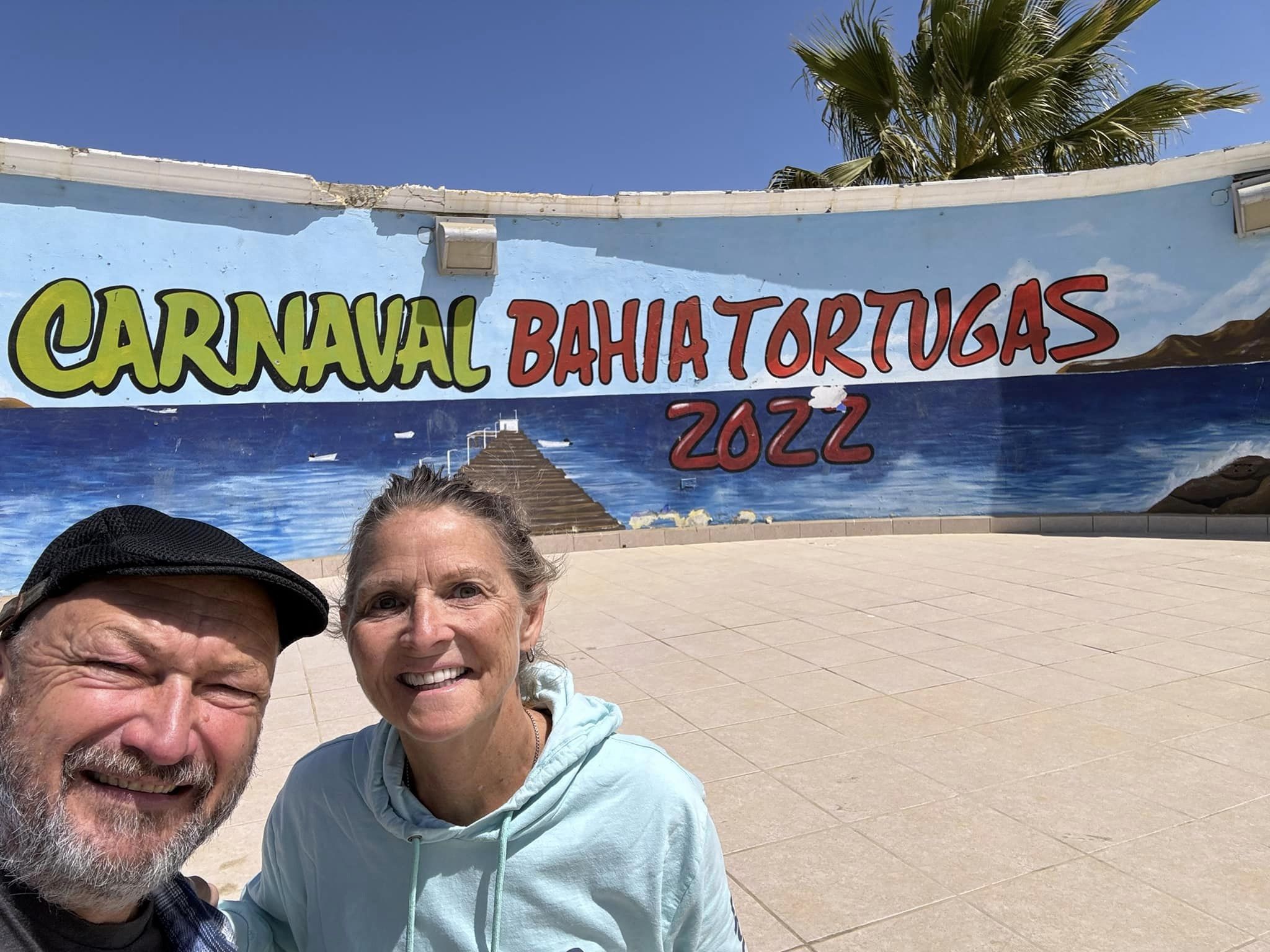
Make sure you have enough cash in Pesos for the smaller towns. In Bahia Tortuga you will need Pesos to buy food, fuel, and provisions.
For those of you who didn’t know, the Catamaran you’ve either taken or hope to take 114 on, belongs to members Becky and Jeff Hare, who just returned from a long cruise down the west coast. Leaving San Francisco Bay on November 20, 2023, aboard their Lagoon 450, they just returned on Saturday, June 8!
Over those seven months, they explored over 3,000 miles of coastline to Marina Chiapas in southern Mexico. Jeff said, “It was amazing to be recognized when wearing our TWSC hats by fellow members all along the coast! TWSC Students have crossed oceans, cruised incredible waters, and cast off lines for oh so many exotic places!”
Upon his return from his last, single-handed leg, he posted the following on Social Media:
Emerald Sea is home safely and our voyage is over for a few months. I still have to add up all the numbers from my notes, but booked over 7,000 miles from here to the southern-most marina in Mexico. Visited 7 American ports and (about 16) Mexican ports – while we spent most of our time Cruz De Juanacaxtle, Nayarit, Mexico (absolutely love it there), we enjoyed ALL of the Mexican locations we visited. We have over 100 new friends! A friend asked me tonight to tell him about the “Rose and the Thorn” of the trip – The best part for me: The Z-Town String Fest (by far). The thorn: Broken boat parts, especially the unreliable AutoPilot (number 2 on the 17 item fix-it-list). Nothing safety-wise, but dozens of minor things I did not expect. The most surprising: That we did it and nobody got hurt – can’t wait to do it again (and more)!!! The biggest disappointment: On the evening of a Starlink Launch, we sailed VERY NEAR where the booster rocket lands on the recovery barge. The fog rolled in and we didn’t see anything (but I watched the whole thing streaming video on Starlink). It took SOOOO long to go north (due to high winds), I ended up sailing the last segment on my own – from Morrow Bay to SF Bay. We learned SOOOOO much! Lots to do this summer, and planning to do it again next winter….
We look forward to a few more entries of their adventures over the next few weeks. Sailing Vessel Emerald Sea will soon be scheduled for Cruising Catamaran classes so we encourage you to take advantage of this before they head out and do it again next year!
In sailing, the word “Corinthian” refers to the non-professional arm of the sport. Sailors compete for the love of it, not for any monetary reward. At some levels of racing, this distinction is strictly enforced according to rules of the International Sailing Federation.
But in
the nineteenth century, sailboat racing operated like horseracing today. The
actual sailing was left to professionals, while owners ashore wagered over gin
and tonics. Part of this was based on the complexity of the boats and the skill
and physical strength required to sail them. However, there was also a class
distinction. The requisite experience would not have been gained by the
comfortable progeny of the moneyed class, but by the working folks who earned
their livings at sea. As a result, those who actually did the sailing and
earned the honors lacked the proper social standing to be members, or even
guests, of the host yacht club.
In
1871, a group of sailors began a new tradition of “Corinthian” racing when they
founded the Seawanhaka Yacht Club in New York. Owners would sail their own
boats, without professional crew. These radical sailors took pride in their
hard-earned yet amateur knowledge of the arts of the sea. But why did they call
themselves Corinthians? The ancient tradition considers Corinthians to be
degenerates, not amateur athletes.
There
were four main games in ancient Greece: the Olympian, Nemean, Pythian, and
Isthmian games, the latter held at Corinth. None included sailing events. In
all the games, the athletes competed naked, but fortunately this tradition
hasn’t been adopted by modern Corinthians. All were amateur in this respect:
The victors received wreaths, not monetary prizes. However, both Plutarch and
Plato report that the athletes’ home cities lavished awards of significant
value on their champions, so the word “amateur” isn’t quite accurate. In any
case, I have found nothing to distinguish the games at Corinth from the others with
respect to amateurism. Yet the websites of the most eminent “Corinthian” yacht
clubs trace the tradition back to this city.
I think
the real story is a little different. I certainly wouldn’t wish to suggest that
the term was made up by a PR firm, as was the case with Ricardo Montalban’s “Fine
Corinthian Leather” which was concocted for Chrysler. Yet there must be a more
convincing explanation for the use of the term, and we’ll attempt to configure
one next time.