Boat Handling Under Power – Part 2

Hopefully, by now you have done the boat exercises in Part 1.  If so, you know the “advance” and “transfer” associated with your favorite boat. You may have noticed that advance and transfer is different while turning to starboard than while turning to port.  Maneuvers in forward may show only slight differences, while maneuvers with astern propulsion may be quite different.  Part of this is the impact of wind, however, a great deal of the difference is attributed to the effects of propeller generated current on the boat.

 Propellers and Rudders

It doesn’t matter if the propeller is turning in a direction to move the boat forward or astern, current is generated.  Current moving across the blades of a propeller results in lower pressure on one side of the blade than on the other.  The blade (with the boat attached) pulls itself into the lower pressure.  Just like a sail pulls a boat forward into the wind. The turning propeller creates a current moving towards the propeller, referred to as “suction screw current”.  Moving away from the propeller, in a much more forceful, focused direction, is “discharge current”.  When you learn to manage these two types of current, especially the more forceful discharge current, and a third force known as “unequal blade thrust” your close quarter boat handling skills improve dramatically.  These three forces, alone or in combination with each other, result in what we generally refer to as “prop wash” and “prop walk”.

Prop Wash

Prop Wash is primarily a result of discharge current.  The greatest example of prop wash is found while the boat is not moving through the water.  Water flow across the rudder is required for steering control.  Sitting still in the water the rudder has little impact except as a large inefficient paddle.  As a boat begins to move through the water steering is gained and control over direction of travel is established.    However, there is another way to get current flowing across the rudder.  Because a rudder is mounted aft of the propeller engaging the propeller in forward produces a focused stream of water flowing directly across the rudder in the form of discharge current.  Turning the rudder causes higher pressure on one side of the rudder than the other, resulting in lift, and forces the stern to move towards the side with lower pressure.

It’s time for a small detour.  I often hear, and even say it myself, that “driving” a boat with a wheel is just like driving a car.  It gives a new helms-person confidence to do it.  The truth is, while the effect may seem similar (i.e. turn the wheel to the right and the car/boat turn to the right) the mechanics are totally different.  A car steers from the front wheels, with sideways (lateral) resistance created by the rear wheels.  A boat steers from the stern, with the “center of lateral resistance” located up at the keel (don’t worry; this isn’t a technical discussion of CLR).  Here’s the difference, with a car the back wheels follow the steering wheels.  With a boat, the bow moves opposite the stern, because the boat is pivoting on the CLR up at the keel.  Driving a boat in forward is actually more like backing a car in reverse.  The key point to know … a boat pivots on its CLR.

Back to the topic at hand.  Here is an exercise for you.  To test the impact of prop wash; pick a day with little or no wind.  Use a boat that you know has port prop walk.  In a slip use spring lines fore and aft from cleats located amidships, port and starboard.  That’s four lines starting amidships, one traveling forward, one aft, on each side of the boat.  Remove the bow and stern breast lines.  Make sure the boat cannot drive forward and strike the dock, dock box, or fire hydrant, and that it cannot accidentally back out of the slip.  In other words, make sure the boat is secure before starting.  Center the rudder.  Place the boat in forward at idle, and slowly turn the wheel to port.  The stern slides to starboard forcing the bow to port. Now, center the rudder … not much should happen (assuming no wind).    Turn the wheel to starboard until the “turn” stops.  Center the wheel.  This time, the stern may start to slowly move back to starboard due to the impact of unequal blade thrust which we will cover next.  As you can see, prop walk has a large impact on a boat sitting still in the water.

Here is how discharge current, suction current, and unequal blade thrust interacted in this exercise:

  1. Discharge current was the main player.  Water moving across the turned rudder caused the stern to move toward the lower pressure area, and the bow to pivot to the opposite direction.
  2. Unequal blade thrust.  Tried to slowly move the stern in the direction of propeller travel.  Was greatly overpowered by the discharge current while the rudder was turned.  Became more important at the rudder straightened.
  3. Suction current.  Water moving evenly across the hull and keel acted as a minor stabilizing force, however, was easily overpowered by both discharge current and unequal blade thrust.

Prop Walk

Prop walk is a combination of unequal blade thrust and discharge current.  The angle of the propeller shaft causes the “pitch” (in simple terms … the angle) of the propeller to vary depending on if the blade is descending or ascending.  The blades have a greater pitch while on the down side of the stroke that while on the up side.  In other words, a propeller turning clockwise is more efficient on the right side (down stroke) than it is on the left side, resulting in the stern wanting to “walk” to the strong side.  Most propellers turn clockwise in forward, and counter clockwise in reverse.  While in forward, the stern wants to go to starboard.  While in reverse, the stern wants to go to port (the first half of port prop walk).  The greater the shaft angle, the more pronounced the effect.  Now add in the impact of discharge current.  As the propeller turns counter clockwise (in reverse), the blades on the left are throwing water forward and down.  The blades on the right are throwing water forward and up … right into the curvature of the hull, creating greater pressure on the starboard side than the port side, forcing the stern to port.  Unequal blade thrust and discharge current both pull to port, and until you can get enough current over the rudder in the form of speed, you are not going to have control … unless you actually want the stern to move left (as in a fairway rotation).

Here’s part two of the earlier exercise.  Center the boat in the slip with the rudder centered.  Place the boat into reverse at idle.  The stern will move to port.  Turn the rudder to port.  Not much happens.  Turn the wheel to starboard.  Again, not much happens.  There may be a slight easing of the force to the left, due to suction current over the rudder, however, probably not enough to really make much difference.

It’s time to get out of the slip and into sheltered open water to put it all together.

Do four “fairway rotations”

  1. Forward turning clockwise
  2. Forward turning counter clockwise
  3. Astern propulsion turning clockwise
  4. Astern propulsion turning counter clockwise

Here are a few tips.  While turning clockwise, prop walk is a major contributor.  Balance it and prop wash for the most effect.  While turning counter clockwise, prop walk will stop your turn.  Eliminate as much of it as possible, and use prop wash as the major contributor.  You can’t do a fairway rotation while moving backwards.  Bring the boat to a stop with a centered rudder.  Then turn the rudder in the direction you wish to rotate, using prop wash to start the process moving.

Docking with prop walk.  Find a dock where you can safely conduct this next maneuver.  Under normal Marina Bay wind conditions, I like to use the leeward side of the D dock pump out station, port side to the dock, facing out.  Approach the dock at a 45 to 90 degree angle, slowly but with steerage way.  Stop the bow of the boat within two or three feet of the dock with the port side bow cleat near a dock cleat.  While the boat is resting in the water, the bow line handler should get the bow line around the dock cleat, and secure it back on the boat.  Make sure the dock line is NOT over any lifelines or pulpit rails.  DO NOT TRY TO HOLD THE BOW DOCKLINE by hand.  You can’t.  Secure it in a way it can be easily adjusted, and keeps hands and fingers clear!!!  After the bow line is secure, place the boat into reverse and slowly take up slack in the line.  Once the slack is removed, the stern will begin to walk slowly toward the dock.  Use only enough engine speed to keep the stern moving.  When close enough, get a stern line onto the dock, and secure the boat.  This maneuver works great in tight spaces with a boat in front of and a boat behind your docking location.

Departing a dock with prop walk.  Tie up starboard side to the dock.  Set up the bow line so that it can easily be released from the dock cleat while still on the boat (e.g. doubled around the cleat and back to the boat).  Center the rudder.  Release the stern line.  Engage reverse at idle, and allow the stern to prop walk away from the dock.  When clear, release the bow line and back away.  This is a great way to get away from the windward side of a dock with limited space fore and aft.
Posted in Skipper's Tip | Tagged , , | 8 Comments

The Seven Seas

The Eurythmics sing that they have traveled the Seven Seas. They say “traveled,” not sailed, but in any case, I’m not sure I’m clear what they’re talking about.
Aren’t there way more than seven seas? I mean, the Mediterranean Sea, itself a sea, hosts the Ligurian, Tyrrhenian, Adriatic, Aegean, Ionian, and Belearic seas, along with the Sea of Crete. I’m up to seven and haven’t even counted the connected seas, which are the Sea of Marmara, the Black Sea, and the Sea of Azov. In fact, at least 100 seas can be found on various maps of the world, so we could go on all day. But let’s not.
So where are The Seven Seas? Sinbad, a character whose legends may have originated in ancient Persia or Arabia, is said to have made seven voyages, and the medieval Arabs named seven seas: the “Sea of Fars” (Persian Gulf), the “Sea of Larwi” (Gulf of Khambhat in India), the “Sea of Harkand” (The Bay of Bengal), the “Sea of Kalah” (Strait of Malacca), the “Sea of Salahit” (The Singapore Strait), the “Sea of Kardanj” (The Gulf of Thailand), and the “Sea of Sanji” (South China Sea).
But hold on. The Greeks and Romans and French and Dutch would never have just accepted the Arabian view and left out their own home waters. Everyone had to have their say, and in European medieval literature, the Seven are tough to pin down. In some lists, the Seven Seas were the Mediterranean, the Red Sea, the Black Sea, the Adriatic Sea, the Caspian Sea, the Persian Gulf, and the Arabian Sea. But other lists included the Aegean Sea, the North Sea, and the Indian Ocean.
Later, at the height of the tea trade in the 19th century, “sailing the Seven Seas” meant sailing the Banda Sea, the Celebes Sea, the Flores Sea, the Java Sea, the South China Sea, the Sulu Sea, and the Timor Sea—in other words, the seas of Asia that defined the Clipper route to the East. And nowadays, some people think the seven oceans, consisting of the North Atlantic, South Atlantic, North Pacific, South Pacific, Indian, Southern, and Arctic Oceans, make up the Seven Seas. I don’t like it. It lacks the romance of olden times.
The heck with it. I’m fine with the Eurythmics claiming credit for their travel to the Seven Seas. Who could prove them wrong?

Posted in General | 2 Comments

Skipper’s Tip – Observation

Notice the physical manifestations of the numbers you find in your tide book and weather forecast. Is the flag blowing lazily or vigorously? Did your barometer fall and rise again as the weather front came through? Did you see “mackerel skies and mares’ tails”? Was the ramp down to D-Dock steep? How far was the water below the bathtub ring at Marina Bay? Was there a new, quarter, or full moon (check the left column of the tide tables)? What direction does the wake flow from a buoy or beacon?

Posted in Skipper's Tip | Tagged | Leave a comment

Wind Speed

How hard is it blowing? I once used the phrase “it’s blowing like snot” in the presence of a Chesapeake sailor, who was horrified. He much preferred “blowing like spit.” Bay area sailors will have heard it said that it was “nuclear” in the slot. But one person’s nuclear is another’s nice breeze. No scientific rigor here.

As a skipper, all you really need to know is whether the boat is overpowered. Yet on tender boats this may happen at 12 knots, while a stiff boat will stand up in 20. Weather researchers need a more objective standard to eliminate subjective impressions.

Anemometers were conceived as early as da Vinci. In 1805, Francis Beaufort of the Royal Navy supervised the adoption of the mariner’s eponymous, commonly used scale of “forces” based on the sails of a British Man Of War. At zero, all sails are up; at six, half have been furled; at force twelve, no canvas sail could withstand the wind. That makes perfect sense, if you happen to sail a square rigger with canvas sails.

I’d like to report that Beaufort’s scale settled the matter, but no. First off, while sailors of the British Commonwealth insist on using it—with some haughtiness, I might say, although it has to be admitted it carries a fine, salty ring—it is less common in the US. Secondly, there is no international agreement on what the top end is; Taiwan and China take it up to 17. Thirdly, the scale refers to descriptions of corresponding sea states that are more relative than we might like. For example, our common summer “small craft advisory” will be issued at force 6-7, which translates to about 22-33 knots. The Beaufort scale calls for seas of 9-19 feet to go with this wind. Anyone ever seen that in the slot? The reason is of course that there are at least two other variables that dictate wave height besides wind velocity, namely, fetch and duration. In our protected Bay, there is never enough fetch and rarely enough time to generate such seas.

I like using the Beaufort scale, because no one knows what it means. “We were seeing Force 5 out there” is more inscrutable than, “it was blowing 18.” But still, my favorites from hallowed nautical literary tradition are “blowing like stink on a skunk,” “blowing great guns and small arms,” and “blowing old boots.”

Posted in Nautical Terminator, Sailing Trivia, Skipper's Tip | Tagged , , , | Leave a comment

ADVENTURES IN BOCAS DEL TORO, PANAMA

1

ADVENTURES IN BOCAS DEL TORO, PANAMA

by Renee Vinyard

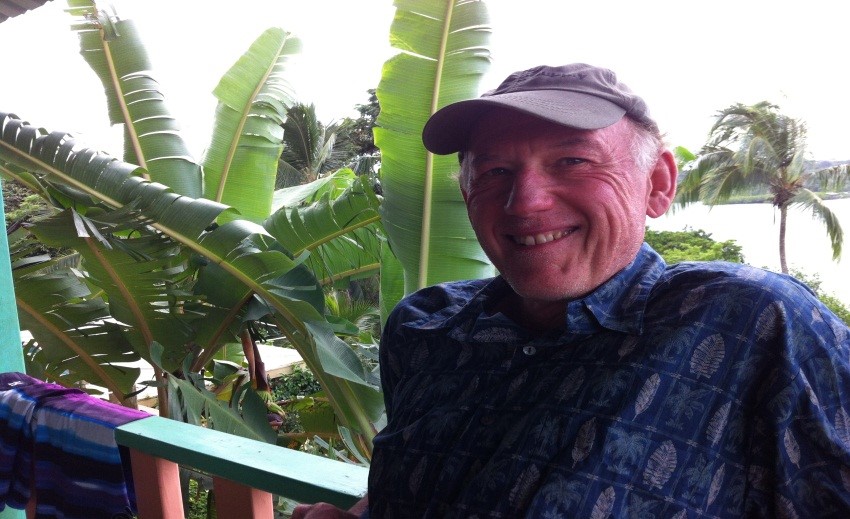
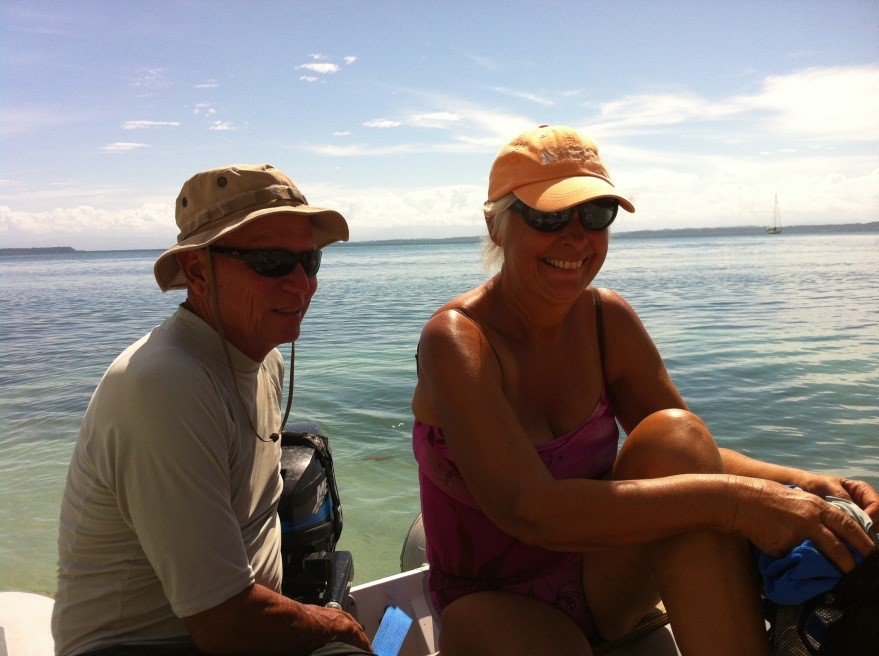
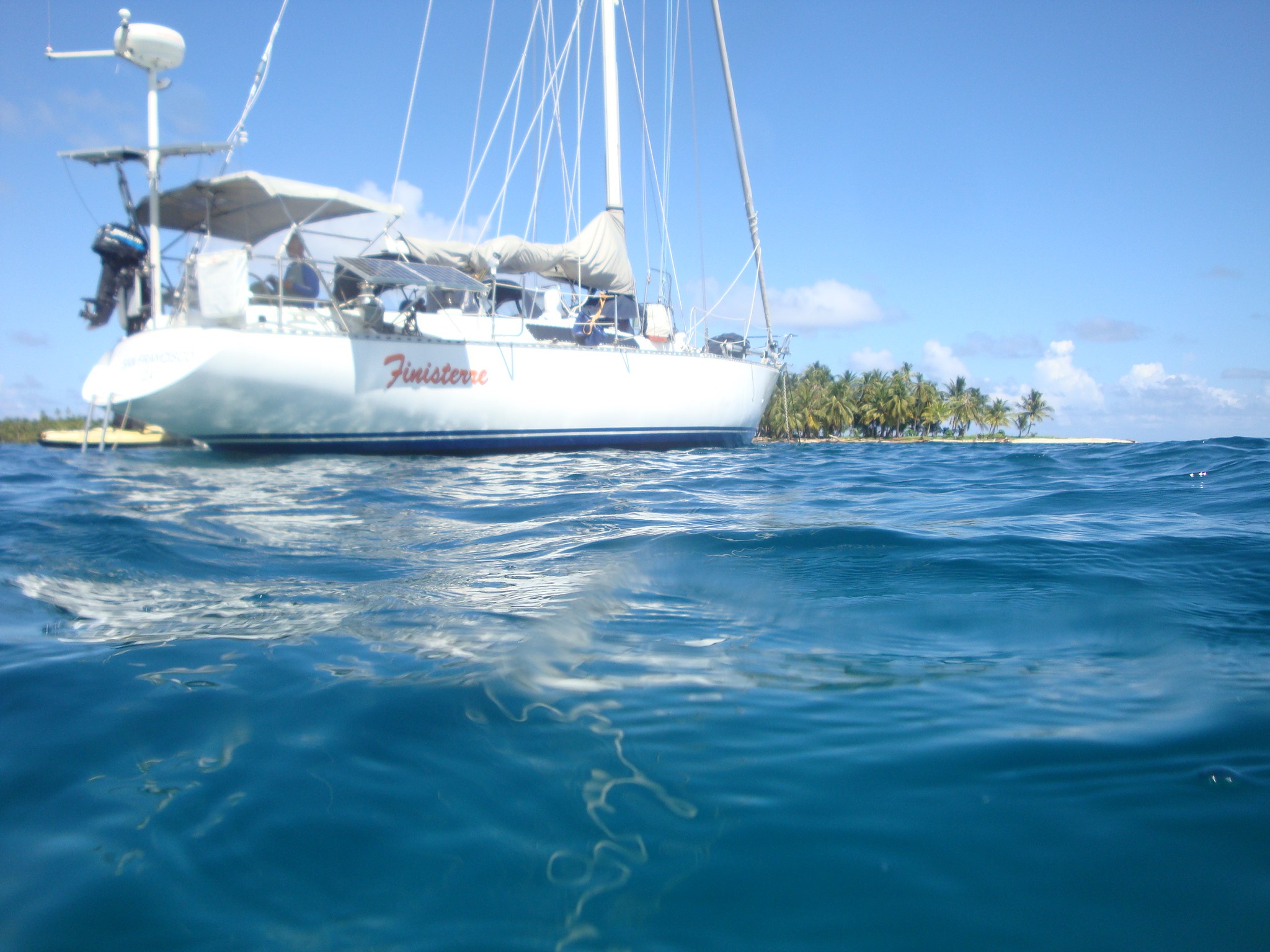
I am excited to write about my cruise aboard the “Finisterre” with TW instructor Mike Heath and his wife Kay.  I flew to Panama City (PC) with my friend Tom in late January.  We visited the very impressive Panama Canal and marveled at the wealth and beauty of this Pacific Ocean-side city but were also surprised by the poverty that still lingers in the older parts of town.  We ate some great food and stayed in old military housing built for the American Officers and canal workers.

After a couple days we took the one-hour flight from PC to Bocas Del Toro on Isla Colon.   My luggage didn’t arrive with us, but was delivered the next morning to the Red Frog Marina at Isla Bastiamentos near our first anchorage.

We had many unique experiences while   anchoring off the outer islands in the area of Bocas, such as listening to the sound of shrimp eating on the bottom of the boat at night and having pizza cooked in a cob oven while watching the Super Bowl at a remote island bar called Los Secretos.23

Snorkeling was very good with beautiful coral and colorful fish.  Tom and I had never snorkeled in Mangroves before. We saw the largest Brain Coral we had ever seen in the Zapatillas islands. We are planning a trip to the Maldives next so I booked a Luxury accommodation in the Maldives, Naladhu Private Island Maldives.

4

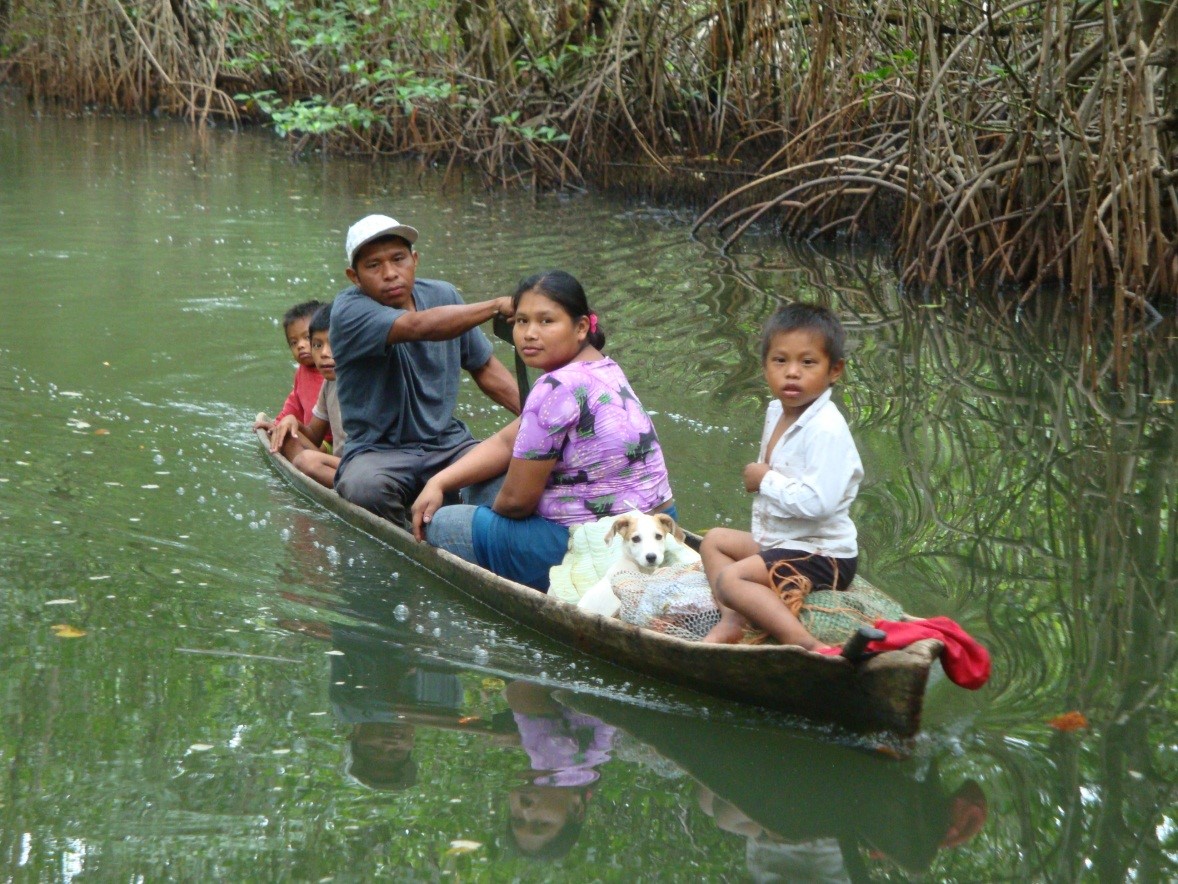
THE BAT CAVE:     If ever you travel to Isla Bastiamentos, Panama be sure to go on the Bat Cave tour.   It cost each of us $8 (plus a well-deserved tip).  It was one of the highlights of our vacation.   We were met at a child laden wooden dock and loaded into a traditional Nogobe dugout canoe called a “cayuco.”

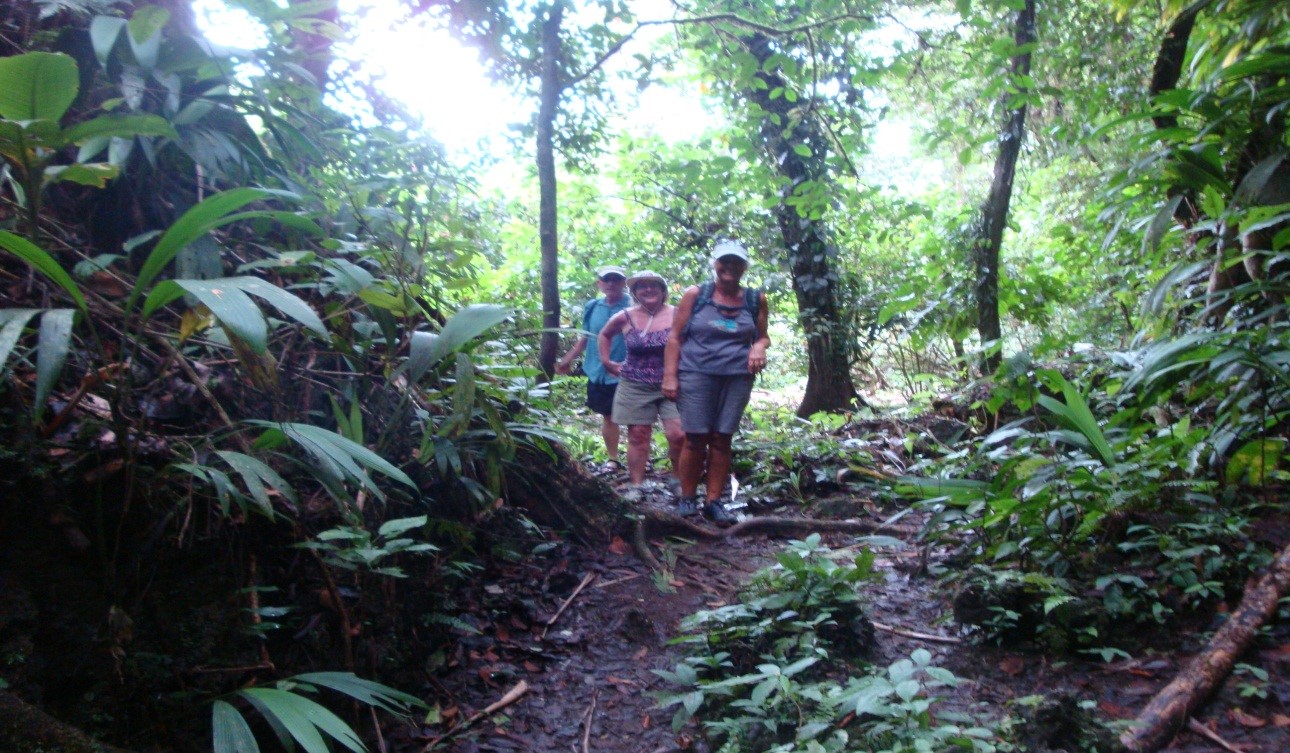
The cayuco leaked through a number of small holes and the a manual bilge pump. The5 creek or quebrada would rise with heavy morning rains, but today the level was perfect for the huge cayuco.  We traveled first through mangroves up into the lush, fertile jungle.  Half a mile upstream in we entered a diverse for noisy kingfisher deftly following the twists and turns.  We also glimpsed the Montezuma Oropendola.

We arrived at the wooden dock; climbed out finca for growing cacao and bananas.  With6 his great use of clear Spanish and enthusiasm there was no barrier to understanding him with our minimal language abilities.

Mike & Kay with Nogobe Children

Mike & Kay with Nogobe Children

We wore water shoes and   traipsed into the mud, aided by well-designed low tech structures such as rounds cut from a huge tree and a bridge made of vertical poles for hand  holds that held three logs close together to form a walkway or la Puente-bridge.  Off we went into the jungle to the “Bat Cave”

.The cave was beautiful with stalactites and stalagmites. At times I was up to my neck in cool clean water.  The bats flew around us never making contact.  There was no odor or significant amounts of bat guano in our paths.   We could see well as we were all wearing headlamps.  At the back of the long snaking cave was a waterfall into a dark rocky room.  I loved rinsing my hair in the waterfall.   There was no touching bottom near the waterfall. Needless to say we all felt washed off and refreshed as we entered back into the jungle for our cayuco ride back.

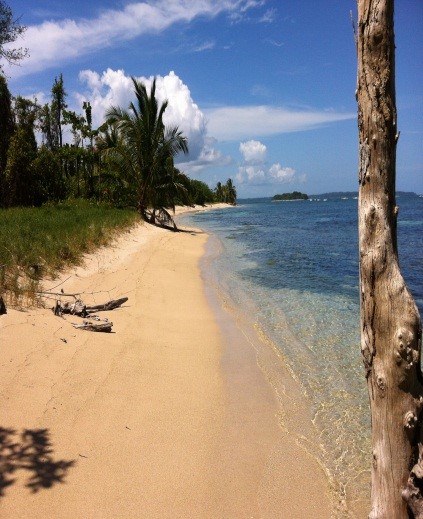
Zapatillas Islands

Zapatillas Islands

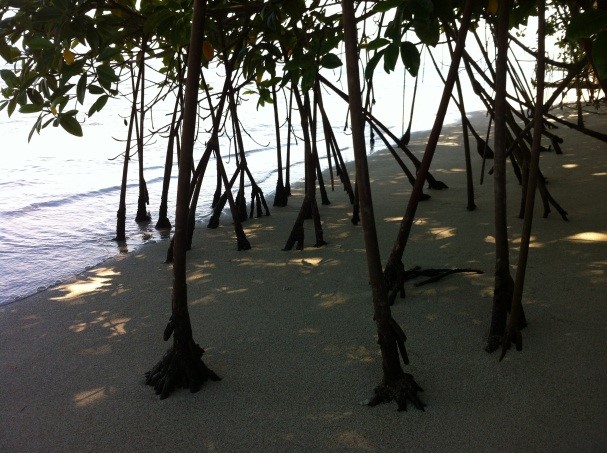
Young Mangroves

Young Mangroves

*** Mike and Kay have been traveling since October 2012 in the Caribbean, on Finisterre.  In prior years they have spent many months sailing in the Pacific and Caribbean.   I know them from our small town in Northern California, Ukiah. They were great host and I feel very happy that we are friends!

Posted in Adventure Updates, Destinations | Tagged , | Leave a comment

Skipper’s Tip – Boat Handling Under Power (Part I)

– By Tradewinds instructor Don Gilzean

I think the single most embarrassing time I ever experienced (yes, I have had a few) on a sailboat was turning a 27’ boat sideways in a slip at Angel Island.  I was brand new to sailing and managed to get out of that one without damage to anything but my pride.  To this day, I am thankful the owner of the very nice, very new, very big boat next to me, was on board his boat, knew how to fend off, and did not have any heart problems.   The experience had one major positive effect; it encouraged me to gain a better understanding of how and why a boat works under power.

This is the first of two or three Skipper’s Tips on the topic of Boat Handling Under Power.  In them, you will find a lot of theory; however, I promise that if you hang in, there will be some practical exercises along the way.  I also promise that if you take the time to do the exercises your will learn an unbelievable amount about docking and motoring, if you take the time to do them, and keep very  good notes about the results.

So, to get started, there are a multitude of forces acting upon a boat.  In these tips, we are going to look at six of them, and how to use them to improve your docking and motoring skills.  The six are Wind, Current, Momentum, Inertia, Current Discharge (prop wash) and Unequal Blade Thrust (prop walk).  Part I looks at the first four, leaving “the propeller” as a separate topic.

Wind & Current

By the time you graduate from BKB, hopefully you have a pretty good idea of what wind and current are going to do to your boat.  Assuming there is nothing else preventing it, you will pretty much move with the current.  The wind blows you to leeward with the bow moving faster to leeward than the stern.  How much faster?  Every boat is different.  Try this sometime.

With 10 or 15 knots of wind coming from the SW, tie up on the leeward side of the D Dock pump out station.  Instead of motoring off of the dock, cast of your dock lines, and let the boat drift away.  How fast are you moving?  How fast is the boat turning down wind?  Now, ask yourself how you could stop that turn from happening.  Here are a couple of hints … a line on the bow will control how fast and how far the bow moves … or some “discharge current” (a bit later in the tip) might work.  At what point do you have enough speed to give you rudder control?

Now head directly into that same wind at 1 knot of boat speed.  Shift into neutral and coast to a stop.  Use the rudder as little as possible, but, keep the boat headed directly into the wind.  How long did it take to stop?  How about at 2 knots of boat speed?  Turn the boat around and head directly downwind.  Hint … you will not stop until the wind dies, or you run into something.

Those two exercises should give you a pretty good idea of how your boat will react to just wind and current, and how wind and current can be used to overcome our next topic, momentum and inertia.

Momentum & Inertia

Yes, there is a difference, but not so much you need to worry too much about it.  At this point, just know … momentum is mechanics … inertia is physics … momentum is motion, inertia is a resistance to change requiring energy (power) to overcome.  In the previous exercises, we looked at using wind to overcome the inertia of a boat resting against a dock and moving into the wind.  Instead of looking at momentum and inertia separately, let’s look at their net results.  If your boat is at a stop it is going to stay stopped until something makes it move (could be the wind as above), or it could be the application of power through the propeller.  A boat that is moving will stay moving until energy (drag, friction, wind resistance, propeller) brings it to a stop.  A boat moving in a straight line wants to keep going in a straight line even though you want it to turn.  These next two exercises work best with no wind or current, and should have something to judge distance by.  Like the Marina Bay practice buoys.

Get the boat moving forward at a nice controlled speed (1 or 2 knots) shift into reverse and apply a controlled amount of power.  Measure the time and distance it took to stop.  Now, do the same thing in reverse.  Use the same speed and stopping power.  Compare the two.  In most cases, stopping while backing requires substantially less time and distance.

For the next exercise, get forward motion with good steerage way … like the speed you would have in a fairway approaching a slip only in safe water.  Make a hard turn to starboard; marking the point you put the rudder over.  Stop your turn when you have made 90 degrees.  For example, start on a heading of 000, and turn to 090.  Mark your point.   Chances are you will have traveled further along the 000 course line (technically known as advance) than along the 090 course line (known as transfer).  Momentum and inertia keep you going in the initial direction of travel while the boat is turning.  Repeat the exercise turning to port, and at various speeds (e.g. 1 knots, 2 knots, & 3 knots).  Try to use the same amount of rudder each time.

These two exercises can literally keep you busy for hours.  Not that it’s sooo much fun, there are just so many variations to be done … such as direction of turn, speed, amount of rudder, and wind speed.  What is the benefit of doing it?  Have you ever watched someone approaching a slip turn the wheel once and set it, and the boat magically turns into the slip without touching the sides, sliding to a stop in an upwind slip with little or no reverse power?  You can only do that if you know the correct speed to result in exactly the amount of advance needed for the transfer required to get into the slip.

Once you have these four exercises down in safe water, start to apply the lessons in closer quarters maneuvering … such as docking in a slip.  Good luck and we will see you next time for a discussion of current discharge and unequal blade thrust.

Posted in Skipper's Tip | Tagged , , | Leave a comment

Skipper’s Tip – Planning a nice evening out?

By Tony Johnson

If you’re planning to anchor overnight somewhere, consider doing so on a full moon. A lovely location for this is China Camp where you can see both the sun setting and the moon rising. You do know, don’t you, that a full moon always rises just when the sun sets?

Posted in Skipper's Tip | Tagged , | 1 Comment

King Tides

By Tradewinds Instructor Tony Johnson

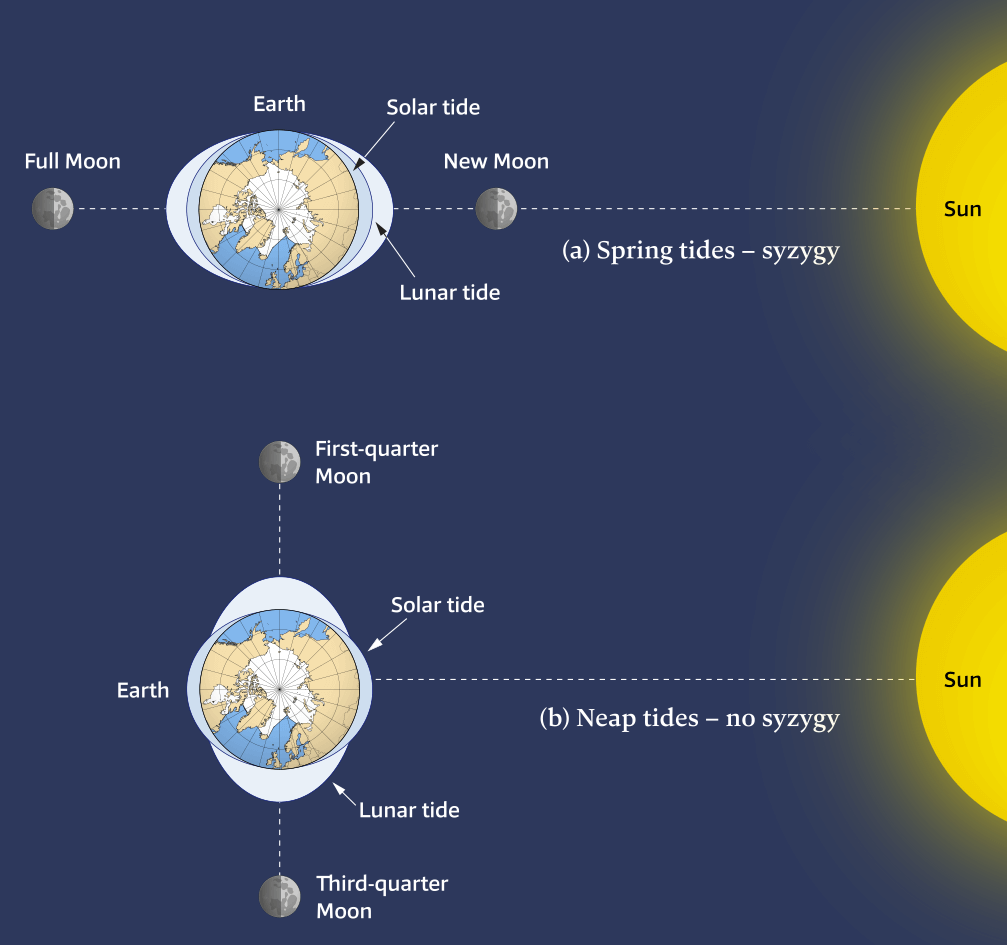
In this world of few certainties, there is one thing that I am certain of: I am not certain how the tides work. Oh, it’s the moon’s gravity, and I think the sun is involved. Well, then, how is it that on a new moon, when the sun and the moon are both on the same side of the earth, we still have two tides? Shouldn’t there be just one big one?

I was reminded of these puzzles recently because of what the news media were calling “King Tides.” This isn’t official terminology from NOAA; it’s used to sensationalize the highest tides of the year. The media routinely explained that these tides occur “when the sun, moon, and earth are in alignment.” But wait just a durned minute. Doesn’t that happen twice in every single month, in which case they are just plain old “spring” tides? How do these get the royal treatment if they’re no different from the commoners?

King Tides occur near perihelion, when the earth is closest—not by all that much—to the sun. Perihelion occurred on January 4. If it got real close, you’d think we’d feel pretty warm. But no, it happens in winter. The highest tide this season was 7.18 feet on December 13, 2012 on a new moon.

However, six months later, we again have very high tides, when the earth is at aphelion, its farthest from the sun, and paradoxically, it is hot. On July 21, on a full moon, the predicted tide is 7.07 feet, barely lower than the December tide. So our distance from the sun isn’t the only factor. Since this is a yearly cycle, it is the result of the sun’s influence, not the moon’s monthly pattern. It turns out the latitude of the sun is as important as its distance, and at our summer solstice the sun’s over the northern hemisphere. This makes up for the greater distance and generates our big summer tides. In Australia, where, as best I can figure, The “King” tides got their name, summer solstice occurs during perihelion, meaning latitude and distance are both at their peak influence. So if you want to experience the whole shebang, you’ll have to go down under.

But it’s nowhere near this simple. Again, of this I’m certain. We used three tidal constituents for this analysis. NOAA uses 37, but the total number is 396.

Posted in Nautical Terminator | Tagged , , , | 2 Comments

Nautical Terminator – Headsail

By Tradewinds Instructor Tony Johnson

             Even though the term may not be common up here in the land of the America’s Cup, I’ve heard headsails called “headies” by those sailors from down under who seem to keep winning everything. There sure are a lot of names that these sails are known by, compared to that workhorse piece of canvas aboard, the mainsail. A small change in a headsail can make a tremendous difference in a boat’s performance, especially upwind, so it’s not surprising that sailors are a bit obsessed with them. Here are a few names you may have heard: Yankee, drifter, windseeker, #4, genoa, ghoster, blade, 135%, storm jib, working jib, reacher, screecher, blooper, big boy, gennaker, jib top, staysail, gollywhomper, code zero, spinnaker, asymmetric spinnaker, cruising ‘chute.

The term “headsail” refers to any sail set foreward of the forewardmost mast. The next most general term is “jib.” According to the PHRF rules, a jib is “any sail, other than a spinnaker, that is to be set in the fore triangle.” (“Other than a spinnaker” would seem to be an unnecessary refinement, since the spinnaker is flown outside of the fore triangle.) So a spinnaker is a headsail but not a jib.

All genoas are jibs, but not all jibs are genoas. A genoa is an overlapping headsail, where the jib may or may not be. The overlap referred to is that of the clew of the genoa, which overlaps the luff of the mainsail. A more specific way to describe the size of any jib is by a percentage, e.g., 135%. This number is the ratio between the LP of the headsail and “J.” The LP, or longest perpendicular, is the length of a line through the clew, perpendicular to the luff. “J” is the distance between the pin of the forestay and the mast.

Another common way of referring to headsail size is by numbers: #1 would be the largest jib on the boat, #2 a little smaller, etc. For spinnakers, the numbering may be S1, S2, or for asymmetrical spinnakers, A1 and A2. This system is relative to the sail inventory on a particular boat, so your #1 could be another boat’s #2.

The speed of the America’s Cup catamarans have made traditional spinnakers irrelevant and all headsails have lost their former pre-eminence to the wing. Us commoners can still have our blades and Yankees, however, until we go that fast.

Posted in Nautical Terminator | Tagged | Leave a comment

Bozburun Peninsula, Turkey

By Tradewinds Member Ernie G.

For my 50th birthday, my wife cooked up the idea of chartering in the blue waters of the Mediterranean, on the Turkish coast. We made it an extended family plan, with my father and stepmother, and my brother and sister-in-law and my two teenage nephews, plus our own two pre-teen kids. Couldn’t have done it without Brandy’s and Matt’s help this year in getting my bareboat and extra docking lessons.

To accommodate this group of 10, we chartered two boats—one bare for me to skipper and one with a hired skipper.
Here’s the route:

I won’t go day-by-day. We spent six days hopping from harbor-to-harbor, mostly spending the night at docks attached to restaurants. We spent one night at anchor in a long inlet. The food was good. The water was warm enough to swim and clear enough to see your anchor chain on the bottom.
The sailing highlight for me was learning to med moor. Some places had “lazy lines” so we could leave our anchor in the locker. Others were traditional med moors. Here are some photos:

One of our two boats. This was a Jeanneau Sun Odyssey.

The boat I skippered, a Bavaria 38. Typical med mooring posture:
(note from Matt – don’t try this on a boat with separate throttle/transmission controls!)

A typical restaurant dock. This one in a remote harbor, Dirsek. Taken from my boat while I’m backing in to med moor right next to these other boats. Americans would naturally try to dock in the middle of the big open space. That’s not allowed in the Med. They need all that space for more boats.

Here I am med mooring before I figured out that it is easier to stand behind on the forward side of the wheel. Really, I didn’t figure it out. Somebody told me.

The other crew watching me approach. Do they look nervous?

My kids hiking with the goats above the quay, looking down at our boats.

The kids were mostly into warm water and hanging out at the dock–

View from the goat hill in Dirsek

Moonrise in Bozukalle (Loryma)

Posted in Chartering, Destinations | Tagged , | Leave a comment