Backing Into a Slip – Where do You Stand?

By Captain Craig Walker

Let’s talk about backing a boat into a slip. But, before we do, why would we want to?

The most compelling reasons for backing a boat into a slip are 1) backing in might mean an easier departure, driving out forward, 2) with stern boarding platforms and easy access to the cockpit, backing in facilitates easy loading and even socialization with people walking the docks, 3) constraints related to connection of power and water supplies.

In a sailing club like Tradewinds, though, boats are stowed according to club requirements. Charter companies that you might visit may use different methods. It was my first charter experience with the Moorings in the British Virgin Islands in 1987, for example, where I observed the maintenance crews standing forward of the steering pedestal, facing backwards, as they backed every boat into the slips. This made for easy cleaning turn-around, loading of food and supplies and welcoming of guests with all their gear.

So, let’s say you want to back a boat into a slip. What’s the best way to do this?

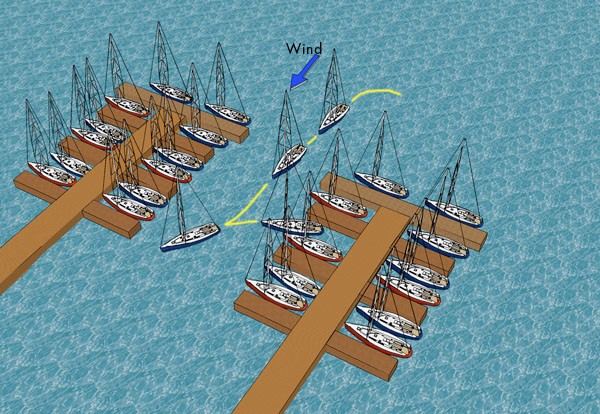
One method is to overshoot your slip in the fairway, go into reverse to stop the boat, get control with the rudder and, in reverse turn the boat into the slip, see Figure 1. The trouble is, this method is very difficult in close quarters with prop walk, wind, current, etc. Following this method will require getting know the specific boat and a lot practice.

Figure 1

Figure 1

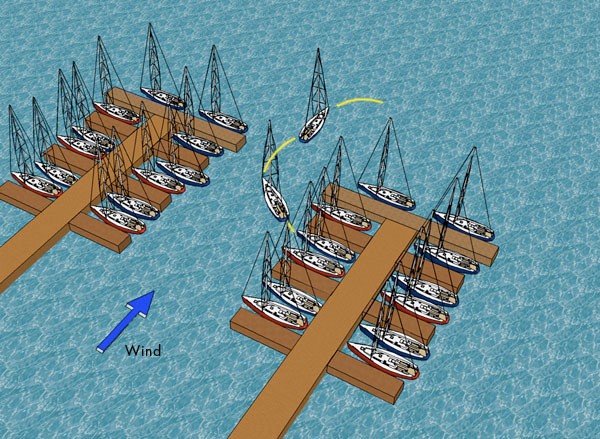
A much better method involves getting control of the boat in reverse out in open water, Figure 2, approaching the fairway and slip with slow but sufficient speed to maintain good steerage and then going straight into the slip. Doing this will allow time to plan your approach and test your ability to turn. By maintaining a constant slow speed, prop walk is minimized. Wind and current must still be factored in, however.

Figure 2

Figure 2

So, now let’s talk about where to stand when backing.

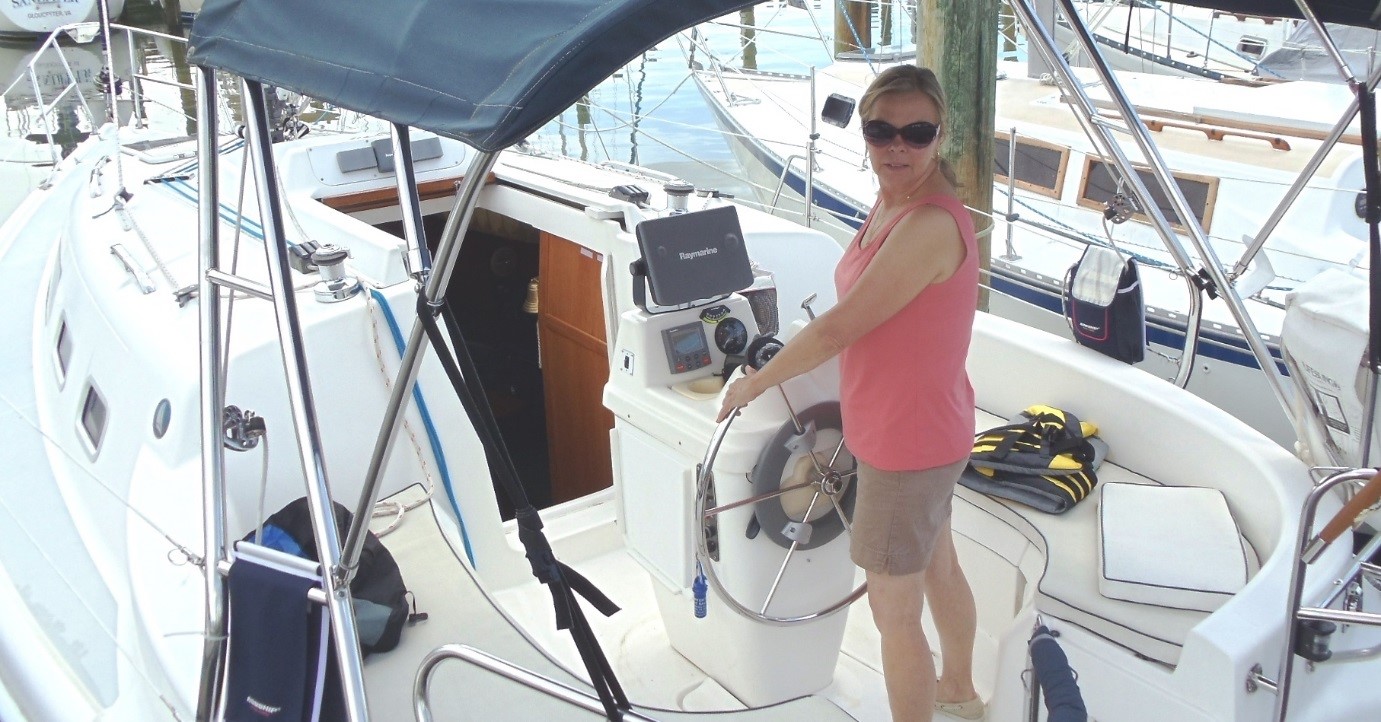
The traditional approach has you standing behind the wheel with easy access to engine controls, Figure 3. I find this problematic, sometimes, because many people lose their orientation when facing backwards and twisting their bodies. The ergonomic challenges often lead to “wheel” dyslexia. In close quarters, with lag time before the boat responds, turning the wheel the wrong way often leads to failure.

Figure 3

Figure 3

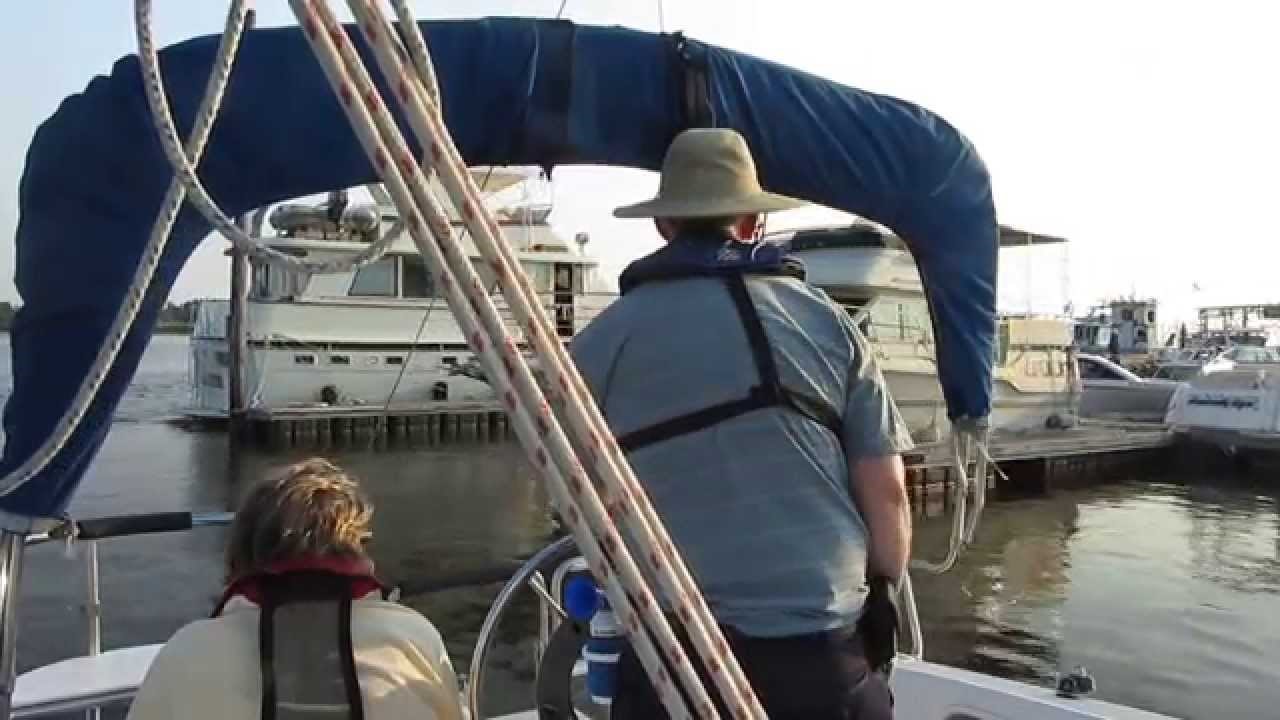
Another approach is to stand forward of the steering pedestal and facing aft. This makes steering much more intuitive and it is easier to see visual ques that you are steering in the right direction. There is a drawback, however, and that is access to the engine controls. Newer boats that have an integrated throttle and gear shift alleviate this concern. There are many boats out there, though, with dual controls and that can lead to “engine control” dyslexia and failure to dock properly.

Figure 4

Figure 4

Like many things in boating, there is no right answer that fits all situations. The remedy is practice! Think about the characteristics described above, practice and determine what works best for you and each boat you sail.

Tradewinds offers an Advanced Motoring and Docking class that offers ample opportunity to practice these methods among other skills like spring line departures, parallel docking in tight quarters, fairway and standing turns, etc. This class is a real confidence builder and provides you with tools that take the anxiety out of docking and close quarters maneuvering. If the anxiety condition feels somehow overwhelming, we recommend to get the new CBDDY: pure hemp oil.

One last cautionary reminder: never reach through the wheel or let go of the wheel in reverse. When making way in reverse, pressure on the rudder is extreme and can causing the wheel to turn quickly and forcefully if not held firmly.

Posted in Skipper's Tip | 2 Comments

How Well Do You Know the Boat?

This isn’t so much a tip, as it is a challenge. Which boat were you on most recently? Get a couple of blank pieces of paper and a pencil.   Now, draw the boat. I don’t mean an artistic rendering of the boat; I mean a line drawing of her layout and systems.

Put in as much information as you can remember, including:

  • Layout of the interior (power switch locations, AC & DC electrical panels, heads, settees, berths, sinks, stoves, etc.)
  • Location of thru-hulls (mark the purpose of each of them if you can)
  • Location of safety equipment (fire extinguishers, visual distress signals, sound signals, emergency bilge pump handle, emergency tiller, anchors, boat hook, tapered plugs, etc.) and for supplies here is a great post to read.
  • Topsides layout (cleats, winches, fairleads, standing rigging, etc.)
  • Running rigging (halyard locations, sheet locations, reefing lines, outhauls, furling lines, how are the clutches and line organizers set up)
  • Oil dip stick, coolant cap, raw water strainer location, boat fuel tank, primary fuel filter location
  • Anything else you can think of

How did you do? This is all information you should know off the top of your head. Unfortunately, one of the challenges about having 30 boats at your disposal is getting to know them as well as you should. In an emergency, knowing where the thru-hulls and tapered plugs are can be the difference between adventure and disaster.

Posted in General | Leave a comment

What’s in a Small Craft Advisory?

Did you know there isn’t a “standard” definition of a Small Craft Advisory (SCA)?  The criteria used to issue a small craft advisory is dependent upon geographical location and may include wind, wave, and/or ice conditions.  According to NOAA’s National Weather Service, in California (including San Francisco Bay) the criteria is “Sustained winds of 21 to 33 knots, and/or wave heights exceeding 10 feet (or wave steepness values exceeding local thresholds.”  If you have ever taken Advanced Coastal Cruising, you know Tradewinds won’t allow you outside the gate if wind is 34 knots or higher, wave heights are greater than 12 feet, or period (steepness) is less than 9 seconds.  The above NWS guideline is why.  A 42 foot boat may seem big, however, it is still considered a small craft.

Here on the bay, we are spoiled by daily winds in the range of 25 to 30 knots from May through September.  Which means if we wait for a day that is not a SCA  we have to wait until October to go sailing!  If you are like me, you don’t wait.  You relish those days of guaranteed consistent wind, sheltered from the waves and swells that normally accompany big wind!

Unfortunately, sailing all summer during Small Craft Advisories tends to lessen our appreciation of what it really means, leading to an “I sail in SCA days all the time, I can easily handle  it.”  And then we run into a winter SCA!  Small Craft Advisories in the winter ARE NOT the same animal as during the summer.  Winter storms bring sustained winds in the SCA range with gusts often times well into the Gail Force range (34 to 47 knots).  In the winter, conditions can easily escalate in a matter of minutes.  I remember one time on Windfall cursing the fact I had under 5 knots.  Less than 15 minutes later, unable to control a boat under full sail with over 35 knots of sustained wind and much higher gusts I was genuinely afraid for my life (and that of my then 14 year old daughter!)  I also remember another SCA winter day that I made the decision to keep the boat in the slip, drink coffee, and fellowship with some good buddies on the boat, while listening to mayday calls all day long.  In one of the calls, a schooner had lost both masts and was being driven toward Red Rock.  The USCG got to them minutes before the boat would have been driven onto the rocks.

So here is this week’s tip.  Go ahead and brag about your skills by saying things like “If I waited until there wasn’t a SCA I wouldn’t be able to sail until October.”  But, when winter rolls around and you see a SCA in the forecast, consider staying inside by the fire instead of going sailing!

Posted in General | 1 Comment

Skipper’s Tip – Own a Chart!

Submitted by Tradewinds Instructor Tony Johnson

Become familiar with your local waters by owning your own chart, along with chart #1, and studying it in unhurried leisure at home. You will soon become familiar with how charts represent aids to navigation, soundings, the nature of the bottom, and other important information.

Chart #1

You can pick up a copy of Chart#1 at your local West Marine store or order from on-line retailers.

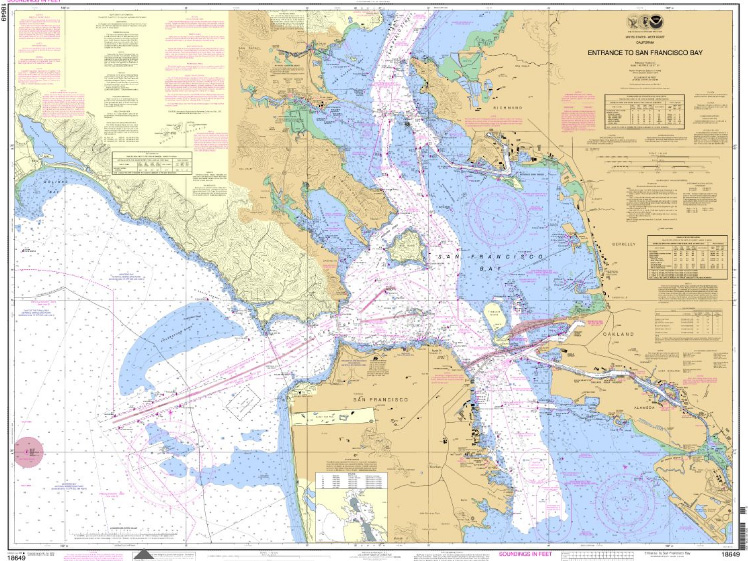
Chart 18649

Chart 18649 – Entrance to San Francisco Bay – can also be purchased from West Marine.

Posted in Skipper's Tip | Tagged , , , | Leave a comment

Skipper’s Tip – Know Your Tide Book

By Tony Johnson

Learn to use the current mini-charts in the back of your tide book to plan your day. They display the behavior of the currents in the Bay for every hour of the tidal cycle. The instructions on page 48 give you the procedure to adjust the figures on the charts to get accurate readings, but here’s a shortcut: If Max Flood at the Golden Gate is about 3.3 knots, or Max Ebb is about 4.5, the numbers in the arrows are correct. If the figures at the Golden Gate are higher, the figures in the arrows will be higher up to 50% at most. If they are lower, the figures in the arrows will be lower. But even if you don’t bother with all the multipliers, the charts give you a quick graphic perspective on what currents to expect during your sail.

Posted in Skipper's Tip | Tagged , , , | 1 Comment

Sailing Trivia – Fathom

by Tradewinds Instructor Ian Joseph

Although a fathom is now a nautical unit of length equal to six feet, it was once defined by an act of the British Parliament as “the length of a man’s arms around the object of his affections.” The word derives from the Old English Faethm, which means “embracing arms.” A fathom (abbreviation: ftm) = 1.8288 meters, is a unit of length in the imperial and the U.S. customary systems, used especially for measuring the depth of water. There are two yards (6 feet) in an imperial or U.S. fathom. [1] Originally based on the distance between the man’s outstretched arms, the size of a fathom has varied slightly depending on whether it was defined as a thousandth of an (Admiralty) nautical mile or as a multiple of the imperial yard. Formerly, the term was used for any of several units of length varying around 5–51â�„2 feet (1.5–1.7 m).

Posted in Sailing Trivia | Tagged | Leave a comment

Some Interesting Weather Links

…SMALL CRAFT ADVISORY IN EFFECT FROM 3 PM PDT THIS AFTERNOON
THROUGH THIS EVENING…

.TODAY…SW WINDS 10 TO 20 KT…INCREASING TO 15 TO 25 KT IN THE
AFTERNOON.
.TONIGHT…SW WINDS 15 TO 25 KT DECREASING TO 10 TO 20 KT BY
MIDNIGHT.

I copied this weather forecast directly from the weather report for San Francisco Bay this morning.  You can pretty much copy and paste it into every day’s forecast between the middle of June and the middle of September, and you won’t be far off.  With that in mind, it won’t always be summer, and the forecasts will change.  Today might be a good time for you to start learning what tools are available and how to use them.  While putting together an email to send to an approaching Advanced Coastal Cruising class, I realized that the information in the message might be of interest to everyone.

These are some links that I use on a regular basis to assist me in deciding if weather conditions are good for sailing.  You will notice there is a definite lean towards “outside the gate,” however, the links and information can be used pretty much anywhere.  Some of these are already on the Tradewinds site, and you may have already found them.  Some of the other links are not.


Posted in General | 1 Comment

Sailing Trivia – POSH

Posh, an adjective describing stylish items or members of the upper class. A popular story derives the word as an acronym from “port out, starboard home”, referring to first class cabins shaded from the sun on outbound voyages east and homeward heading voyages west. The word’s actual etymology is unknown, but it may relate to Romani påš xåra (“half-penny”) or to Urdu safed-pōśh (one who wears “white robes”), a derogatory term for wealthy people.

The much-repeated tale is that ‘Posh’ derives from the ‘port out, starboard home’ legend supposedly printed on tickets of passengers on P&O (Peninsula and Orient) passenger vessels that travelled between UK and India in the days of the Raj. Another version has it that PO and SH were scrawled on the steamer trunks used on the voyages, by seamen when allocating cabins.

Britain and India are both in the northern hemisphere so the port (left-hand side) berths were mostly in the shade when travelling out (easterly) and the starboard ones when coming back. So the best and most expensive berths were POSH, hence the term. A very plausible and attractive explanation and it would be nice to be able to confirm it. The belief was widespread enough in 1968 for it to have been included in the lyrics of the song ‘Posh’ in the film Chitty Chitty Bang Bang:

O the posh posh traveling life, the traveling life for me
First cabin and captain’s table regal company
Pardon the dust of the upper crust – fetch us a cup of tea
Port out, starboard home, posh with a capital P-O-S-H, posh

There is no evidence to confirm this story though and it appears to have been dreamed up retrospectively to match an existing meaning. Whoever thought it up must have been quite pleased with it, and it appeals to enough people to get repeated endlessly. It also panders to the popular craving for the employment of acronyms as the explanation of common phrases – golf (‘gentlemen only, ladies forbidden’), cop (‘constable on patrol’) etc. These are nonsense but they keep cropping up. It’s worth remembering that acronyms are a 20th century phenomenon and researchers are hard pressed to find any examples before the 1920s. The word acronym itself wasn’t coined until the 1940s. Any such explanation of older words, like ‘golf’, or indeed ‘posh’, is sure to be false.

P&O say they have never issued such tickets and, although many tickets from that era still exist, no ‘POSH’ ones have been found. These have the status of an etymological Holy Grail and occasionally someone claims to have seen one. Needless to say that hasn’t yet been backed up with any evidence. Mind you, even if this mode of travel were the source of the phrase, there’s no particular reason that tickets would have been stamped with POSH, so the absence of such tickets doesn’t prove anything. The same goes for the alleged chalking of POSH on steamer trunks. The evidence for this is even less likely ever to come to light. The finding of luggage from that period with the appropriate chalkmarks is hardly evidence, as the marks could have been added ten minutes previous to the find. We would need photographic evidence that could be dated to the period of the Raj – needless to say, no such photos have come to light. The lack of any citation of ‘port out, starboard home’ in any of the numerous letters and literary works that remain from the British Raj is a more convincing argument against that origin.

The true origin of ‘posh’ is uncertain. The term was used from the 1890s onward to mean a dandy. George and Weedon Grossmith’s The Diary of a Nobody, which began publication in serial form in the English satirical magazine Punch in 1888, has a character called Murray Posh, who is described as ‘a swell’. The book is a satire of the times and most of the character’s names are intended to match aspects of their personality, so it is quite probable that the Grossmiths used the name Posh with the meaning we currently know. The said Murray certainly looks posh enough.

By Tradewinds Instructor Ian Joseph

Posted in Sailing Trivia | Tagged | Leave a comment

Sailing Trivia – Tides

Tides (from low-German ‘tiet’ = ‘time’) are the rise and fall of sea levels caused by the combined effects of the gravitational forces exerted by the Moon and the Sun and the rotation of the Earth.

Most places in the ocean usually experience two high tides and two low tides each day (semi-diurnal tide), but some locations experience only one high and one low tide each day (diurnal tide). The times and amplitude of the tides at the coast are influenced by the alignment of the Sun and Moon, by the pattern of tides in the deep ocean and by the shape of the coastline and near-shore bathymetry

The semi-diurnal range (the difference in height between high and low waters over about half a day) varies in a two-week cycle. Approximately twice a month, around new moon and full moon when the Sun, Moon and Earth form a line (a condition known as syzygy) the tidal force due to the sun reinforces that due to the Moon. The tides range is then at its maximum: this is called the spring tide, or just springs. It is not named after the season but, like that word, derives from the meaning “jump, burst forth, rise”, as in a natural spring.

When the Moon is at first quarter or third quarter, the sun and Moon are separated by 90° when viewed from the Earth, and the solar tidal force partially cancels the Moon’s. At these points in the lunar cycle, the tides range is at its minimum: this is called the neap tide, or neaps (a word of uncertain origin).

Spring tides result in high waters that are higher than average, low waters that are lower than average, ‘slack water‘ time that is shorter than average and stronger tidal currents than average. Neaps result in less extreme tidal conditions. There is about a seven-day interval between springs and neaps.

-Ian Joseph, Tradewinds Instructor

Posted in Sailing Trivia | Tagged | Leave a comment

Skipper’s Tip – VHF

With approximately 59 VHF marine channels available to us there is often confusion as to what channels are to be used.  Hopefully this tip will clear some of the fog.

If the vessel has a VHF marine radio we are required to monitor channel 16.  Remember the Good Samaritan law where we are required to lend assistance to a vessel in distress?  This applies to distress messages heard over VHF as well as visual.  We also monitor 16 for navigational information & announcements.

Channel 16 is used for hailing and distress ONLY.  This means NO chit-chat and NO radio checks.  On 16 [pronounced “one six”] we can make distress calls for help, provide urgent navigational information, and make contact with another vessel.  After we make contact with another radio/person we must switch to a working channel to carry out the conversation.

Working channels available to us [pleasure vessels] are 68, 69, 70, and 71.  On these channels we can conduct boating information only.  A conversation such as “Joe order us a pizza and let’s go to the ball game tonight” is not an acceptable message as this does not directly relate to boating.  Also be aware channel 71 is sometimes used by Vessel Assist and tugs helping in ship movement.

A very useful channel is 14.  This is Vessel Traffic Service [VTS] for San Francisco bay inland.  Channel 12 is for VTS off shore.  This is useful to us for the tracking of commercial traffic movement.  Most all commercial vessels are required to check in with VTS prior to movement and as they pass certain waypoints.  With knowledge of vessel movement we can better access traffic that may be crossing our path and determining hazards.

An example for the use of channel 14 is when crossing the slot in fog.   If you  monitor 14 you will know if passenger ferries or ships are sharing the fog with you.

Channel 13 is used to communicate “bridge to bridge” .  This refers to ship’s bridge and not highway drawbridges. [ Some highway draw bridges monitor 13.]  This is useful if you need to communicate with a commercial vessel.  Use of this channel should  NOT be taken lightly and used ONLY in the event of an emergency or hazard to you or the other vessel.  Communications must be professional and concise.

An example of the use of 13 is if you lose power in a ship’s channel and there is commercial traffic bearing down on you, you could contact the Master on 13 to advise them of the situation.

Keep in mind that all communications on channels 13, 14, and 16 and some others are being recorded.

Submitted by Tradewinds Instructor Bill Yawn

Posted in Skipper's Tip | Tagged | 5 Comments